Wednesday, June 25, 2014

My first day with UbD

Some of our teachers are going through a 3 day workshop on Understanding by Design (aka UbD or sometimes backwards design). Some basic information can be found here, here, and here. What is kind of unique is that this workshop is only for our math teachers, so as a group they can make connections between this theoretical framework and their day-to-day functioning in the classroom as lead learners of mathematics. Every discipline has their unique set of lenses on how they view instruction, teaching, and learning, so the fact that we have a group of people viewing instruction through the same lens will help them support one another as we journey through this process.

Over the three days, we will come back to the 4 big ideas as a framework for this curriculum design process. Those ideas are:

  • Point of school is effective understanding, not prompted by recall of content and compliance
  • Understanding=using content effectively for transfer and meaning
  • UbD from engaging work and competent understanding, NOT coverage
  • Intellectual engagement is more likely when incorporated intentionally
We had a lot of chance to reflect on our instructional practices and how they relate to student learning. One of the reflective questions was "What is real understanding and how does that differ from a student just "knowing a lot"?". Some of the ideas that we came up with were that if you (a student) really understands, then they can demonstrate what they know and how they know it, they can know when NOT to use a process of learning and catch flaws and errors, and they will make
meaning via active inference in order to effectively transfer to a new context. When students just "know a lot" (without deep understanding), they can only understand what is being demonstrated, but not necessarily demonstrate/teach to others.

We need to help students learn how to apply an abstraction to a practical example. Unfortunately, too many times we leave out the practical examples with authentic applications of mathematics. Additionally, too often focus on students remembering and understanding (Bloom's levels), and leave about 1 day for creating and evaluating. It was suggested to us that we flip Bloom's to treat it like an area map and start students in the upper levels to provide authentic context to help bring the content into focus and it will provide students more opportunities to work in the upper levels of Bloom's even before the "content" is discussed. It was suggested that we let the learning of mathematics begin with a question and analysis and then let the number prove the conjecture. In other words, don't let the numbers and symbols of the language of mathematics get in the way of students learning the mathematics. Students don't need to know all of the details of statistics to have a meaningful discussion of what is fair. Here is an example activity for a student activity on determining what is fair. 

One of the other large takeaway was how authentic learning can take place in the classroom. 


Essentially, authentic learning occurs at the intersection of acquisition of knowledge, making meaning of the knowledge, and the transference of the knowledge and meaning to a novel situation. This image is meant to imply a cycle of learning without a hierarchy or starting point. Students do not necessarily need to know all of the facts and concepts to begin making meaning.

Overall, this was a very good introduction and beginning of a three-day workshop. I am looking forward to diving in more to developing essential questions and developing transfer goals. Those transfer goals are what we would want our learners to understand many years after formal schooling has ended.

Do you have experience with UbD? Have you just implemented the process? What suggestions do you have to share?


Saturday, May 10, 2014

My day of learning at IRA

Today was my first day of learning at the International Reading Association Convention. I have to admit, I had some trepidation attending this conference because this is completely out of my content background. I was a biology and chemistry teacher and then moved into an instructional leader for math and science. Attending a conference full of reading and English teachers seemed a little intimidating. I knew, that because this was out of my normal comfort area, it would be a great learning opportunity and would truly be professional development instead of merely nodding my head in agreement with presenters in my content areas.

The day started with some colleagues, Traci, a fellow administrator, and Lisa, one of our reading specialists. As we were waiting to enter the exhibit hall, we saw the tweets of the conference streaming on a video monitor. Both Traci and Lisa said, what is this all about, so I got the opportunity to show them Twitter as a learning tool and sharing resources from the conference. Both were excited by the opportunities that were presented by using Twitter for learning, professional development, and becoming a connected educator. Please give them a follow by clicking their names above.
Embedded image permalink
Me and Traci in front of the Twitter feed screen


 My first learning experience was with a group from Lego Education and them sharing how Legos and some of their software can help students develop their story telling skills. By utilizing legos, students can do a variety of story related activities including setting the scene, build parts of the story, collaborate in telling parts of the story with classmates, and even build alternate endings. The software would allow for documentation of their learning and the ability to share their creations. The presenter even challenged us to build an alternate ending to the story. Although this was being framed for elementary grades, I fell that this could be used in high schools. Students could build main events from literature they have read for class. They could share their builds and have other students identify symbolism, main characters, and this process can help with students ability to summarize, identify main idea, supporting details, and more. Student active engagement in the build should help cement the information for long term storage, and the use of the software and story boarding can help have some authentic voice and get peer feedback. The activity of creating the alternate ending would be a quality assessment of their understanding of author's intent and the character development. It would propel student thinking into the upper levels of Bloom's and engage them in new active, both physical and cognitive, ways.

My next learning was with Kristin Ziemke. It was strange, but I had to travel to New Orleans to hear her talk about her passion for education and learning networks and transform the PLNs that many of us have for continued learning to a tool her students can use. The strange part is that both of us are in the Chicago area. Kristin advocates and models how Student Learning Networks can be developed and supported by bother the school and parents. Kristin also introduced the concept of transliteracy. She described transliteracy as the ability for students to read, write, and interact with multiple forms of media. It is an interesting concept that I would like to explore later to see what it will look like in different content disciplines. Katie Muhtaris was Kristin's presentation partner, in spirit only due to flight issues, and co-author of their book on this topic of creating a learning environment of connected comprehension.

Lunch was spend connecting with other educators via Twitter and responding to intriguing tweets and responding to tweeps. Food-wise, lunch was very good! I highly recommend the Ugly Dog Saloon! In addition, I met up with another colleague, Cynthia, and got her started on Twitter for learning. Give her a follow also!

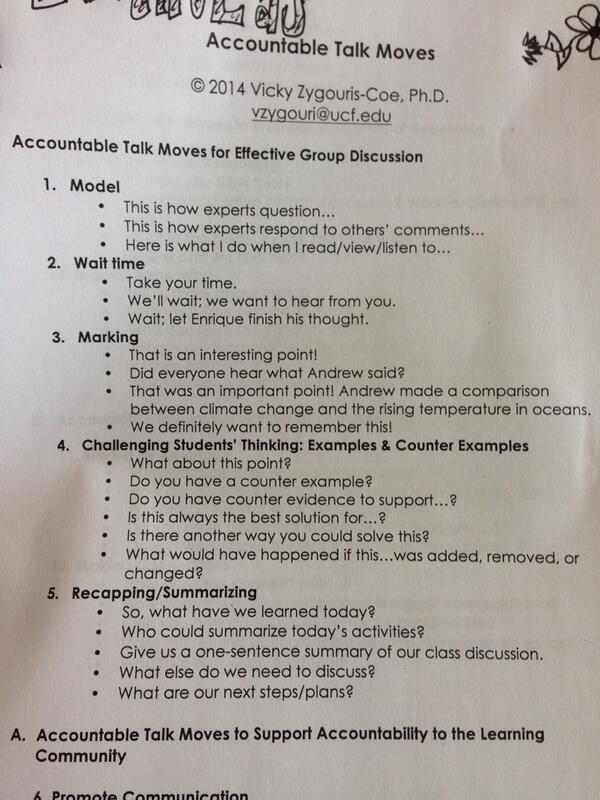
I spent the afternoon learning from Dr. Vicky Zygouris-Coe and disciplinary literacy in math and science. Key takeaways I had from this session are that some of my teachers are on the cutting edge and doing really awesome things in the classroom that are supported by the research and literature. As a part of her presentation, she was modeling effective discussion techniques that she provided in writing (see below).


Embedded image permalink

Additionally, when asking students to participate in discussion, make sure that the desired practices are modeled and that students are engaged in the practice of engaging with one another and meaningful content. When they answer a question, train them in the habit of providing support to their responses. This practice should help their writing skills as well.

All in all, today was a pretty great day of learning. I can't wait to see what tomorrow brings!


Tuesday, May 06, 2014

Assessment practices and diabetes

Below is a diagram of how a human body typically regulates blood glucose levels:

http://static.ddmcdn.com/gif/diabetes-glucose-regulation.gif
The concept show above is common in biological processes. It is known as a negative feedback loop. A negative feedback loop works because a stimulus (in example below blood sugar level) causes an action. The action results are monitored to stop the action once the it has reached an acceptable level. 

In a person who does not have diabetes (either type I or type II), a high level of blood sugar would cause the pancreas to release insulin that would stimulate the cells of the body to take in the blood glucose and causes the liver to go through the metabolic process of changing glucose into glycogen for storage in the liver (See yellow arrows). In a person who does not have diabetes, a low blood sugar level would cause the pancreas to release glucagon, which has the opposite effect of insulin. Glycogen is broken down in the liver and glucose is released into the bloodstream. When an acceptable level of blood glucose has been reached, the stimulation of the pancreas stops and the insulin and/or glucagon is no longer released.

In a person with diabetes, the body has an abnormal blood glucose tolerance and does not produce insulin (type I diabetes) or has decreased sensitivity to insulin or inability to use their own insulin (type II). Either way, the feedback look is broken. Either the stimulus does not begin the action or the action is not stopped after monitoring.

Our current practices in assessment are like a person who has diabetes. The feedback loop is broken. Students participate in instruction, they take an assessment, and instruction continues, regardless of students' results on the assessment.

If we are to actively utilize assessment for learning (instead of assessment of learning), then the use of these assessments must be formative and instruction must be adapted to match the needs of the students (i.e. blood sugar level). 

From Kanold & Larson (2012), Common Core Mathematics in a PLC at Work, pg. 90

As seen in the cycle above, steps three and four are the key monitoring pieces to achieve step 5. Students must be active contributors to the Teaching-Assessing-Learning cycle. They must reflect on their classroom practices, as teacher should, to help alter actions in class. If this learning environment can be cultivated, both students and teachers will help drive needed changed in instruction to meet the needs of students and to assist them in achievement of their learning goals.

Educators cannot continue to provide assessments without the clear understanding of how they will be used to adapt instruction to help students meet the learning targets. If a student does not demonstrate that they have learned the information/skills from a unit, what sense does it make to just push them down the curriculum road map that is scaffolded upon that previous information?!

Diabetes is a disease that is treatable is monitored closely, but at this time, there is no way to fix what is "broken". We can fix the broken part of the teaching-assessing-learning cycle.


Friday, April 04, 2014

Effective discussion facilitation technique

I attended a training recently and much of this day long meeting included facilitated group discussions. The presenter demonstrated some quality discussion techniques that I wanted to write about so I can share with others and so I can remember them.

For reflection, an easy practice is doing a 3-2-1. It can be set as a chart to help the participants organize their thoughts. Knowing that these can be modified, here is what the presenter used: 3 key pieces of information, 2 questions that you have, and 1 think you what to learn moving forward. This is very similar to KWL, but a variation can help teachers or presenters have some different flavors of techniques to keep things fresh and changed to help with group engagement.

For discussion, the presenter previewed the 5 categories/topics that he wanted each small group to discuss. During the designated discussion time, he helped to ensure that group conversation by stating what topic number we should be on at this point in the conversation. While this was not revolutionary in thinking, when we got to the group sharing of the discussion, there was a practice that really resonated with me.

In his assessment of the discussion topics, he recognized and stated  that topic #1 was dominating the conversation, even with his helping the discussion progress. Because of this, he reversed the order of the topics during the group share. This allowed for groups to spend a more equitable distribution of time for each topic and not have the sharing dominated by the "strongest opinionated topic". Information was organized on a chart for all to see with strengths and opportunities for improvement and the comments were sorted accordingly.

The concept of reversing the order of discussion compared to the sharing allowed for topics that might have been discussed for a smaller amount of time be given a little more time for open discussion. Interesting technique!

If you have other strong presentation/discussion facilitation techniques, please share!


Thursday, April 03, 2014

Following conferences on twitter

I had a teacher come to me after attending conference who was excited to tell me about the conference within the conference. She was talking about the use of the conference hashtag to discuss what a keynote speaker was talking about, finding resources from breakout sessions, and finding new colleagues with whom you can connect and from whom you can learn. Her excitement about the new possibilities of connecting and learning got me thinking about my experiences with conference hashtags and connecting to other conference attendees.

When I was talking with another teacher about a conference she will be attending, I described the experience of the other teacher and using Twitter and the conference hashtag. This new teacher is eager to learn new things and was excited by this potential addition to her learning. So she asked, how can I easily follow the hashtag?

My big conflict has always been wanting to use my iPad because of its portability, but needing to use my clunky laptop in order to follow the hashtag on twitter with ease. I love using tweetdeck to establish separate columns for specific hashtags and it allowed me easily know who was new to following me and any notifications and direct messages I might receive. The iPad Twitter app can be used follow a hashtag, but you would miss out on your general stream of people that you follow.

When I asked my PLN about this issues, some of the great people I follow made some suggestions:

Bob Schuetz and Megan Ryder suggested the use of HootSuite. I have used HootSuite to be able to post to multiple networks with one click, but rarely used it as a reader for the networks. It was a good idea and a functional solution because HootSuite has a good app available for both iPhone and iPad.

Megan also shared an idea of Nicole Ring and it blew me away. It was one of those ideas that everyone should be able to think of, but she put idea into practice and shared it. After I saw the idea, I just had to write about it and share it. Nicole's idea involved the iPad web browser and Tweetdeck. She suggested that you log in to Tweetdeck using the web browser, establish your columns as you would on the desktop version, and then save the tile to the home screen. VIOLA! You now have a home made iPad version of Tweetdeck!

I look forward to trying this out at the next conference I attend. I appreciate my PLN for sharing the great ideas that they have!