After I saw a BreakoutEdu at an edcamp, I knew that I wanted to share this with my teachers and get them using it with their students as a new way to engage, collaborate, and problem solve. I knew that some Amazon gift cards would be coming my way so I have all of the items in my shopping cart, ready for purchase. When I began to describe with one of my teachers, she thought that it seems interesting, but wanted to see it in person before she made a monetary commitment.
Then, when she attended the ICE conference, she wandered by the room that was doing a breakout and the facilitator asked if she wanted to come in. She was hooked! She immediately went out and purchased the materials and started to peruse the posted breakouts for her classroom. She immediately took it to the next level by designing her own. She created the theme, the puzzles to solve, and the method to which she was going to have her students participate. She reviewed the puzzles and before she ran with it, she took a very important step. She wanted to test her prototype.
She asked me to come in, as someone familiar with a breakout, and look at the puzzles to see if the clues where clear enough, the instructions were precise, and to discuss the flow of the instruction. We had a great discussion what the puzzles were aiming at, what schema was needed to approach the problems, and what additional resources should be made available. After our discussion, she went back to her lab to make some changes to her puzzles and clues.
After this last iteration, she brought in some other colleagues to run through the breakout as novices. By sharing this with others, excitement was generated and one of the colleagues asked if they could borrow her materials. She was ready to have the students breakout, but the learning was not done.
This teacher ran the breakout with her senior level class first and watched them enjoy and work collaboratively to achieve the solutions. She was surprised at some of the teams that formed because they were not students who typically interacted with one another and some students who usually took a more passive role in the class because active in sharing their knowledge and experiences to reach the solution. She was excited to see the new learning groups that formed organically and collaborative processes that came into play.
In her own reflection of the breakout, she realized that she was very quick to jump in and help the students when they reached a road block. She said that based on this experience, she might need to look at how much struggle she allows for her students before providing a hint and a next step in a solution. She said the look of excitement on students faces was invigorating because they were excited to look up information about the clues and to arrive at conclusions based on their observations.
How often, as teachers, do we need to take a step back and let the students struggle and persevere in their problem solving before stepping in to help? As an administrator, I know that it is valuable in the post conference to let the teacher work their way through a reflection of their lesson before I provide a commentary.
I am proud that this teacher took a risk in developing her own breakout for her first go at it with kids. I am proud of her reflection and growth in the process of its development. Way to go Jackie! (@mathedjax)

Showing posts with label collaboration. Show all posts
Showing posts with label collaboration. Show all posts
Thursday, April 21, 2016


Saturday, May 10, 2014
My day of learning at IRA
Today was my first day of learning at the International Reading Association Convention. I have to admit, I had some trepidation attending this conference because this is completely out of my content background. I was a biology and chemistry teacher and then moved into an instructional leader for math and science. Attending a conference full of reading and English teachers seemed a little intimidating. I knew, that because this was out of my normal comfort area, it would be a great learning opportunity and would truly be professional development instead of merely nodding my head in agreement with presenters in my content areas.
The day started with some colleagues, Traci, a fellow administrator, and Lisa, one of our reading specialists. As we were waiting to enter the exhibit hall, we saw the tweets of the conference streaming on a video monitor. Both Traci and Lisa said, what is this all about, so I got the opportunity to show them Twitter as a learning tool and sharing resources from the conference. Both were excited by the opportunities that were presented by using Twitter for learning, professional development, and becoming a connected educator. Please give them a follow by clicking their names above.
My first learning experience was with a group from Lego Education and them sharing how Legos and some of their software can help students develop their story telling skills. By utilizing legos, students can do a variety of story related activities including setting the scene, build parts of the story, collaborate in telling parts of the story with classmates, and even build alternate endings. The software would allow for documentation of their learning and the ability to share their creations. The presenter even challenged us to build an alternate ending to the story. Although this was being framed for elementary grades, I fell that this could be used in high schools. Students could build main events from literature they have read for class. They could share their builds and have other students identify symbolism, main characters, and this process can help with students ability to summarize, identify main idea, supporting details, and more. Student active engagement in the build should help cement the information for long term storage, and the use of the software and story boarding can help have some authentic voice and get peer feedback. The activity of creating the alternate ending would be a quality assessment of their understanding of author's intent and the character development. It would propel student thinking into the upper levels of Bloom's and engage them in new active, both physical and cognitive, ways.
My next learning was with Kristin Ziemke. It was strange, but I had to travel to New Orleans to hear her talk about her passion for education and learning networks and transform the PLNs that many of us have for continued learning to a tool her students can use. The strange part is that both of us are in the Chicago area. Kristin advocates and models how Student Learning Networks can be developed and supported by bother the school and parents. Kristin also introduced the concept of transliteracy. She described transliteracy as the ability for students to read, write, and interact with multiple forms of media. It is an interesting concept that I would like to explore later to see what it will look like in different content disciplines. Katie Muhtaris was Kristin's presentation partner, in spirit only due to flight issues, and co-author of their book on this topic of creating a learning environment of connected comprehension.
Lunch was spend connecting with other educators via Twitter and responding to intriguing tweets and responding to tweeps. Food-wise, lunch was very good! I highly recommend the Ugly Dog Saloon! In addition, I met up with another colleague, Cynthia, and got her started on Twitter for learning. Give her a follow also!
I spent the afternoon learning from Dr. Vicky Zygouris-Coe and disciplinary literacy in math and science. Key takeaways I had from this session are that some of my teachers are on the cutting edge and doing really awesome things in the classroom that are supported by the research and literature. As a part of her presentation, she was modeling effective discussion techniques that she provided in writing (see below).
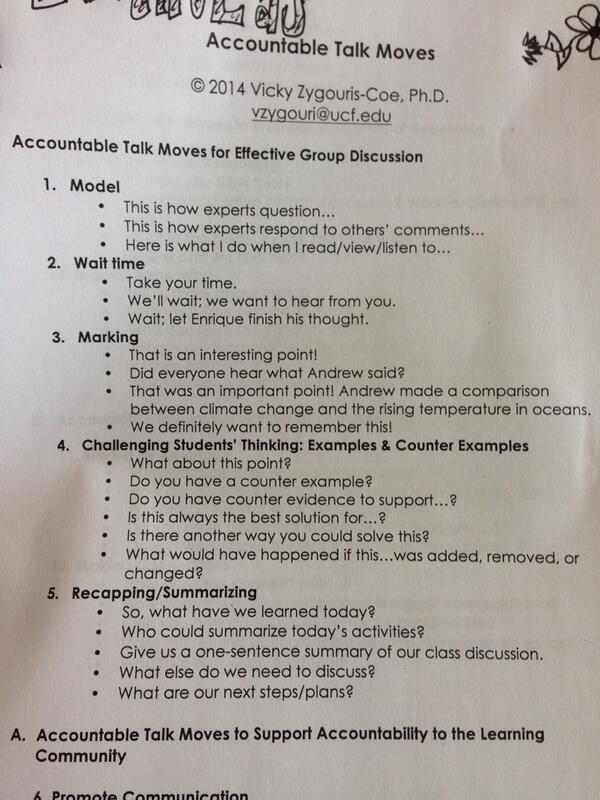
Additionally, when asking students to participate in discussion, make sure that the desired practices are modeled and that students are engaged in the practice of engaging with one another and meaningful content. When they answer a question, train them in the habit of providing support to their responses. This practice should help their writing skills as well.
All in all, today was a pretty great day of learning. I can't wait to see what tomorrow brings!
The day started with some colleagues, Traci, a fellow administrator, and Lisa, one of our reading specialists. As we were waiting to enter the exhibit hall, we saw the tweets of the conference streaming on a video monitor. Both Traci and Lisa said, what is this all about, so I got the opportunity to show them Twitter as a learning tool and sharing resources from the conference. Both were excited by the opportunities that were presented by using Twitter for learning, professional development, and becoming a connected educator. Please give them a follow by clicking their names above.
 | |||||
| Me and Traci in front of the Twitter feed screen |
My next learning was with Kristin Ziemke. It was strange, but I had to travel to New Orleans to hear her talk about her passion for education and learning networks and transform the PLNs that many of us have for continued learning to a tool her students can use. The strange part is that both of us are in the Chicago area. Kristin advocates and models how Student Learning Networks can be developed and supported by bother the school and parents. Kristin also introduced the concept of transliteracy. She described transliteracy as the ability for students to read, write, and interact with multiple forms of media. It is an interesting concept that I would like to explore later to see what it will look like in different content disciplines. Katie Muhtaris was Kristin's presentation partner, in spirit only due to flight issues, and co-author of their book on this topic of creating a learning environment of connected comprehension.
Lunch was spend connecting with other educators via Twitter and responding to intriguing tweets and responding to tweeps. Food-wise, lunch was very good! I highly recommend the Ugly Dog Saloon! In addition, I met up with another colleague, Cynthia, and got her started on Twitter for learning. Give her a follow also!
I spent the afternoon learning from Dr. Vicky Zygouris-Coe and disciplinary literacy in math and science. Key takeaways I had from this session are that some of my teachers are on the cutting edge and doing really awesome things in the classroom that are supported by the research and literature. As a part of her presentation, she was modeling effective discussion techniques that she provided in writing (see below).
Additionally, when asking students to participate in discussion, make sure that the desired practices are modeled and that students are engaged in the practice of engaging with one another and meaningful content. When they answer a question, train them in the habit of providing support to their responses. This practice should help their writing skills as well.
All in all, today was a pretty great day of learning. I can't wait to see what tomorrow brings!
Wednesday, November 06, 2013
Coaching by listening
One of the best parts of my position is discussing what teachers are doing with students in their classrooms. I enjoy the conversations had between colleagues about the choices, practices, and results in their classes. It is a great chance to reflect and I encourage the teachers with whom I work to see the observation/evaluation cycle as the most honest professional development in which they will participate.
As I reflect on my own practices, I stumbled across the Partner Discussion Protocol from a conference I attended. When there are partners working together, here is how it generally works:
As I reflect on my own practices, I stumbled across the Partner Discussion Protocol from a conference I attended. When there are partners working together, here is how it generally works:
·
A shares, B is an active listener (then switch)
·
A shares need, goal, or ideas for evidence
·
B’s role is to probe and push with ?’s
o What’s
going on now?
o Why
do you want this to change?
o What
exactly is your goal (desired change)?
o How will you know is changed?
In the administrator/teacher dynamic, there may not necessarily be the reversal of roles, but idea of identifying the wanted change, defining the reason for the change, and being able to assess if the change has actually occurred is definitely valuable.o How will you know is changed?
As the concept of peer evaluators gains popularity, this model can be applied after a pair of observations has been completed. The role of the active listener is key.
As it has been said: "We have two ears and one mouth so we can listen twice as much as we speak".
Friday, May 10, 2013
Why is it different in school?
I have been in the workforce since the age of 15 and a half. When I first began, it was part time work as a cashier and stock boy in a local pharmacy. If there was a large project that needed to be completed, especially in a short amount of time, a few of us working that day would work together, divide the tasks, and, at the end of the day, report out what was completed and what still needed to be done. The people working the next day would pick up where we left off until the project was complete.
This process continues in my work as an administrator. When a large project comes in, we will sit down, discuss the goals and expected outcomes, divide up the tasks, assign realistic deadlines, and provide progress reports. If one of us runs into an issue or has a question, we ask our colleagues for their expertise, guidance, and ideas. When complete, it is OUR project. While individuals might be recognized for a specific contribution, it is the work of the whole that gets evaluated. We stand or fall together.
As a child, I participated in multiple team sports and learned the skills of cooperation, teamwork, problem solving, settling disputes, providing guidance, accepting assistance. These skills were mirrored at home because I have a sister and we would have to get along. When disputes arose, we had to figure out how to co-exist peacefully.
But, as I grew up, I also received conflicting training and information. For 8 hours a day, 5 days a week, 36 weeks a year, I was told that I needed to work only by myself. I could not confer with others, share ideas, or seek out advice from someone with more experience. In the rare instance that I was able to work with someone else, when it came time for the task completion, I had to complete my own and the credit or fault was all mine. The same was true for anyone with whom I may have worked. Work was duplicated and it was evaluated on an individual basis.
Why the two different systems? Why is it different in school than out in the "real world"?
I understand that in the early grades it is a matter of ensuring that each student has assimilated essential skills in order to effectively participate in a team structure and share in the problem solving. It is even essential to do so in the upper grades as new information is introduced in newer, more complex content areas. But if we focus on skill development, once the basics have been introduced, should we, in the educational world, model the skills and project completion models that the business world is asking for?
Having been a part of our career and college readiness, I have heard from many local business leaders that they would prefer a generalist, who has good communication, teamwork, and problem solving skills, and the business can provide them more job-specific training. That models what Thomas Friedman discusses in The World is Flat. Schools will need to meet the flexibility that the working world has discovered the need for.
Why do schools force isolation, in both practice and assessment? Why does the federal government mandate it...without funding.
Let's try something different! Flip the class, PBL, cooperative assessments...something has to give. Leaders need to be supportive as they push instruction out of the standard comfort zone of the adults to move the learning into the comfort zone of the students!
This process continues in my work as an administrator. When a large project comes in, we will sit down, discuss the goals and expected outcomes, divide up the tasks, assign realistic deadlines, and provide progress reports. If one of us runs into an issue or has a question, we ask our colleagues for their expertise, guidance, and ideas. When complete, it is OUR project. While individuals might be recognized for a specific contribution, it is the work of the whole that gets evaluated. We stand or fall together.
As a child, I participated in multiple team sports and learned the skills of cooperation, teamwork, problem solving, settling disputes, providing guidance, accepting assistance. These skills were mirrored at home because I have a sister and we would have to get along. When disputes arose, we had to figure out how to co-exist peacefully.
But, as I grew up, I also received conflicting training and information. For 8 hours a day, 5 days a week, 36 weeks a year, I was told that I needed to work only by myself. I could not confer with others, share ideas, or seek out advice from someone with more experience. In the rare instance that I was able to work with someone else, when it came time for the task completion, I had to complete my own and the credit or fault was all mine. The same was true for anyone with whom I may have worked. Work was duplicated and it was evaluated on an individual basis.
Why the two different systems? Why is it different in school than out in the "real world"?
I understand that in the early grades it is a matter of ensuring that each student has assimilated essential skills in order to effectively participate in a team structure and share in the problem solving. It is even essential to do so in the upper grades as new information is introduced in newer, more complex content areas. But if we focus on skill development, once the basics have been introduced, should we, in the educational world, model the skills and project completion models that the business world is asking for?
Having been a part of our career and college readiness, I have heard from many local business leaders that they would prefer a generalist, who has good communication, teamwork, and problem solving skills, and the business can provide them more job-specific training. That models what Thomas Friedman discusses in The World is Flat. Schools will need to meet the flexibility that the working world has discovered the need for.
Why do schools force isolation, in both practice and assessment? Why does the federal government mandate it...without funding.
Let's try something different! Flip the class, PBL, cooperative assessments...something has to give. Leaders need to be supportive as they push instruction out of the standard comfort zone of the adults to move the learning into the comfort zone of the students!
Thursday, January 24, 2013
Me vs. We
As I (and many others) have said before, Words Matter!
A relayed conversation got me thinking about Me vs. We. I think it would be an interesting study to interview Superintendents and Principals of comparable schools and districts that are considered successful and unsuccessful (it would take a long time to define that right now) and ask them questions using indefinite articles concerning the schools, students, academic programs, etc. under their charge.
What got me thinking was a conversation told to me of a Superintendent from a school district that is not considered successful through the lens of percentage of students who meet and/or exceed expectations on the Prairie State Achievement Exam (PSAE). [Note: The PSAE is the NCLB mandated 2 day test which consists of the ACT for Day 1 and the Work Keys and a state developed assessment of science content.] When this Superintendent was talking about the schools, students, and academic programs, they continually said "my schools", "my students", etc., but when posing questions to the building principals, this superintendent used "you" and "your". (i.e. What is your building doing for the School Improvement Day?). The superintendent would then respond to the principals, again using "me" and "my".
In my humble opinion, there seems to be an inherent disconnect. Almost an implication that the superintendent could claim credit for any successes found within the schools or district, but then use the distance created between me and you in order to be shielded from an problems or failures. Wouldn't this also feed into an "us vs. them" mentality, if one existed?
I would be curious, in this proposed study, to see if the more successful schools and districts have building and district leaders that continually used "we" and "us", creating that sense of community and the thought that everyone is in it together.
What happens in your school/district? Is it a ME or a WE?
A relayed conversation got me thinking about Me vs. We. I think it would be an interesting study to interview Superintendents and Principals of comparable schools and districts that are considered successful and unsuccessful (it would take a long time to define that right now) and ask them questions using indefinite articles concerning the schools, students, academic programs, etc. under their charge.
What got me thinking was a conversation told to me of a Superintendent from a school district that is not considered successful through the lens of percentage of students who meet and/or exceed expectations on the Prairie State Achievement Exam (PSAE). [Note: The PSAE is the NCLB mandated 2 day test which consists of the ACT for Day 1 and the Work Keys and a state developed assessment of science content.] When this Superintendent was talking about the schools, students, and academic programs, they continually said "my schools", "my students", etc., but when posing questions to the building principals, this superintendent used "you" and "your". (i.e. What is your building doing for the School Improvement Day?). The superintendent would then respond to the principals, again using "me" and "my".
In my humble opinion, there seems to be an inherent disconnect. Almost an implication that the superintendent could claim credit for any successes found within the schools or district, but then use the distance created between me and you in order to be shielded from an problems or failures. Wouldn't this also feed into an "us vs. them" mentality, if one existed?
I would be curious, in this proposed study, to see if the more successful schools and districts have building and district leaders that continually used "we" and "us", creating that sense of community and the thought that everyone is in it together.
What happens in your school/district? Is it a ME or a WE?
Subscribe to:
Posts (Atom)