December has a lot of holidays that emphasize the family, protection, renewal, etc. When I looked for a list of winter festivals, I found way more that I was looking for: http://en.wikipedia.org/wiki/List_of_winter_festivals#December
(After looking for this list, I realized that I had a certain bias toward the seasons of the Northern Hemisphere, so for my Aussie and Kiwi readers, I apologize and hope you are enjoying your summer!)
But, I digress. It can be said in the US (and most probably elsewhere) that this is the season of giving. While there has been a mad scramble to accumulate tangible objects with a specific monetary value (since the Thanksgiving night), I would like to turn my attention to something with much more meaning...the gift of time.
When I was in a school building and I could serve as the administrator in charge, I would always volunteer to work on the day of December 24th so someone else could be with their family and prepare for the holiday. When teachers have expressed a need, I have served as an emergency sub so they could take care of family emergencies or even get on a road a little early to be with family.
I am sure that we can think of personal examples of this all over the place. Maybe you have been the giver, maybe the recipient. The question I had was how has this translated into the classroom? How do we instill this idea of the larger community in our classroom? Social Studies classes seem to be a natural alignment with concepts of civic responsibility, but how can we do this in a science class?
Here is how: We can share with our students volunteering opportunities at local informal places of learning...museums! Here are some links you can share:
Even The Art Institute of Chicago
Not only will these activities look great on a student's resume or college application, it will provide them with a chance to give back to the community and reinforce the concepts being taught in school.
I realize that these are Chicago-specific, but go to a museum website for your area and search "Volunteer". You will find TONS of opportunities that will reinvigorate you and even generate more professional connections making you the constant learner.
Tis the season...

Wednesday, December 12, 2012


Monday, December 10, 2012
Pluto strikes again
If you do not watch The Big Bang Theory, I highly recommend it. Any time 3 physicists with PhDs and an engineer, with only a Master's Degree from MIT, get together, hilarity must ensue...
On a re-run of an episode, they had a great physics joke about one of the simple machines. The set up for this punchline is that Sheldon's (green shirt) friend who is a girl wants him to meet her mother. Leonard (red shirt with purple hoodie and brown coat) has explained that there is no way to avoid the girl changing from a friend who is a girl to a girlfriend. Sheldon doesn't understand so Leonard puts it into physics terms:
It got me thinking about the basic machines that have been studied in classical history. From Wikipedia, there are 6 simple machines listed:
When I look at the six simple machines listed, I think that the list can be condensed to three. The pulley is really a wheel and axle with a groove to provide a channel for a rope or belt. The lever is an inclined plane placed on a fulcrum (which in a simple model is a wedge). And, as seen described in the video clip above, a screw is an incline plane wrapped helically around an axis. The pulley, lever, and screw are all combinations of simple machines, this making them more complex. (We have not included a bicycle or automobile in the list because they are complex combinations, although they are the first of their respective kinds of transportation. Even as my mind wandered to the idea of the airplane and the wing, the wing is merely a modified wedge.) Thus, in my humble opinion, there are three simple machines: inclined plane, wedge, and wheel and axle.
But, in the modern age, I think that the list of simple machines (3 or 6) is incomplete. When we examine what I am using to write this blog post, we come to the computer. As a coincidence of today, as we consider what components the computer can be simplified to, I would be remiss if I did not acknowledge today's Google Doodle:
The doodle of the day depicts Ada Lovelace and her contributions to Charles Babbage's computation machine. So, what simple machine can we take away from the computer? Would it be the monitor, keyboard, mouse, hard drive? Simplify it all down and we get to the microprocessor as the driving engine of the computer.
But even the microprocessor had predecessors: the microchip, the transistor, and the vacuum tube. Do any of these make the list? I would argue that they should not because each can be simplified down even more to the most base components. I would contend that the addition to the list of simple machines should be the circuit.
If you clicked on the link above for circuit, you would see that there are many machinations of the circuit and there certainly is an advantage when they are put to work (may not specifically be a mechanical advantage, but I do not think it would be a hard argument to make to fit the above definition).
So here we are, a historical list of 6 machines that can be argued into 4. Just as in the case of Pluto, what used to be historically accepted as fact should be modified in the modern age.
Do you agree?
On a re-run of an episode, they had a great physics joke about one of the simple machines. The set up for this punchline is that Sheldon's (green shirt) friend who is a girl wants him to meet her mother. Leonard (red shirt with purple hoodie and brown coat) has explained that there is no way to avoid the girl changing from a friend who is a girl to a girlfriend. Sheldon doesn't understand so Leonard puts it into physics terms:
It got me thinking about the basic machines that have been studied in classical history. From Wikipedia, there are 6 simple machines listed:
- Lever
- Wheel and axle
- Pulley
- Inclined plane
- Wedge
- Screw
When I look at the six simple machines listed, I think that the list can be condensed to three. The pulley is really a wheel and axle with a groove to provide a channel for a rope or belt. The lever is an inclined plane placed on a fulcrum (which in a simple model is a wedge). And, as seen described in the video clip above, a screw is an incline plane wrapped helically around an axis. The pulley, lever, and screw are all combinations of simple machines, this making them more complex. (We have not included a bicycle or automobile in the list because they are complex combinations, although they are the first of their respective kinds of transportation. Even as my mind wandered to the idea of the airplane and the wing, the wing is merely a modified wedge.) Thus, in my humble opinion, there are three simple machines: inclined plane, wedge, and wheel and axle.
But, in the modern age, I think that the list of simple machines (3 or 6) is incomplete. When we examine what I am using to write this blog post, we come to the computer. As a coincidence of today, as we consider what components the computer can be simplified to, I would be remiss if I did not acknowledge today's Google Doodle:
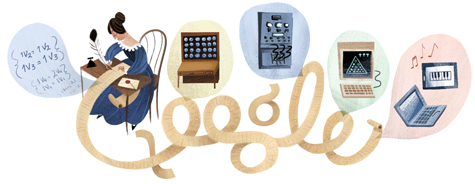 |
| http://www.google.com/doodles/ada-lovelaces-197th-birthday |
But even the microprocessor had predecessors: the microchip, the transistor, and the vacuum tube. Do any of these make the list? I would argue that they should not because each can be simplified down even more to the most base components. I would contend that the addition to the list of simple machines should be the circuit.
If you clicked on the link above for circuit, you would see that there are many machinations of the circuit and there certainly is an advantage when they are put to work (may not specifically be a mechanical advantage, but I do not think it would be a hard argument to make to fit the above definition).
So here we are, a historical list of 6 machines that can be argued into 4. Just as in the case of Pluto, what used to be historically accepted as fact should be modified in the modern age.
Do you agree?
Friday, December 07, 2012
Trying to enlarge the thimble...
 |
| http://dilbert.com/strips/comic/2009-12-04/
Once again, my daily Dilbert desk calendar is prophetic!
While it does not amaze me that all superintendents and assistant superintendents are not up to date on the most recent trends in instructional technology, it continues to baffle me when these leaders do not consult with the people within their organization that does keep up with the trends.
Too often we see grant dollars spent on technology equipment at the last minute without consulting educators who have used the equipment in the field or have at least had discussions with people using the equipment. Authorized signatures seem to always believe the technology sales rep who collects their check and leaves the bulk of the work to people who were not involved in the development of the project.
Case in point, I know of a district that is purchasing low-cost tablet laptops. Great idea...except with this new purchase, the director of IT was never consulted (about the purchase, the effect on the infrastructure and wireless network, manpower needed to physically ready and tag all of the machines...), nor did they talk to a neighboring district who went through this process and could describe the pitfalls they went through and how to avoid them. And guess who is going to be left holding the bag? Teachers who will get about one hour of PD on how to turn the machine on...
Now, part of the issue may be with the state and the fed. Grant notifications seems to always come with less than a 2 week turn around time. School districts do not want to look bad to their court of public opinion by denying an opportunity for funding, so they quickly put together a proposal and then heaven forbid the proposal gets approved! Now, comes the scramble of trying to make a pipe dream a reality.
But, I am not about pointing out problems. I want to try and fix them.
I am thrilled that I have had the opportunity to go to some wonderful conferences this year and I have learned a lot and connected with a lot of great people. The ISTE Leadership Forum was a wonderful event and I have made the recommendation for as many administrators attend this conference as possible next year. I informed my boss that I was approved to present at ICE with some great people (@stumpteacher, @principalkmelt, and @tomwhitby) and she told me to extend an invitation to some teachers to attend!
These are some good steps, but I have realized something...when technophiles attend a technology conference, we are the choir getting preached to. I presented some methods of immediate student feedback using mobile devices at a science teacher conference and this is where I may have added a new tenor or two to the choir...I think we need to expand our outlook and begin presenting at our content area conferences about technology. This might plant some seeds in maiden fields and really expand the 21st century learning pedagogies into more schools.
|
Tuesday, December 04, 2012
Have you thanked your IT director today?
We use Microsoft Outlook for our email system.
The long pause was for all of the Google Apps for Educators users to finish booing and throwing fruit...
Over the past 3 weeks, we have had some interruptions in service. Usually, when we have an interruption in Internet service, it is due to a small power outage, a server switch getting reset, overly stormy and windy day that causes havoc with the alignment of our microwave dishes, website provider server crash, etc. For my 6 years in my current district, these are the first instances of the issue being actually on the Microsoft side.
If you would like to skip the diatribe that will follow and get to my main point, scroll past the section enclosed by the row of asterisks...
********************************************************************************
The first instance happened on the Monday before Thanksgiving. I was going to do some substitute professor-ing at a local university for a colleague of mine who teaches an evening course in methods of reading to pre-service teachers. I have been doing this every semester for the past 4 years and love the opportunity to introduce pre-service teachers to Web 2.0 and technology that can be infused into instruction to increase student engagement. The local university has been under construction and thus, the room where the class is held each semester has changed.
When my colleague asked me to talk with her class again, she sent me a calendar invite with the room number and the time she told the students to show up. I was ready. I had my interactive presentation ready, brief hand-outs, exit slip...these students were going to do some exploring and learning! I arrived at the university about 45 minutes before the class was scheduled to begin, park my car and check my calendar one last time to note the room number...that was odd, the calendar on my iPhone didn't show the event anymore.
I got out of my car and gathered my materials and walked toward the building thinking it must be something with my phone. I would go into the building and log into my web access email and verify the room number. Only problem was that when I logged into the web access email, the calendar was showing a date of November...of the year 2000! This was impressive on multiple levels, one being that for an instant, I thought I had successfully travelled through time, and the other was that I did not work for this district in 2000 and yet they prognosticated that I would grace them with my presence and had established an account for me 6 years before my auspicious arrival. Unfortunately, neither was true.
What had happened was that the authenticating time server that we use (from a US Naval base on Colorado) had an error and its clock got reset to the year 2000. (Those Y2K people weren't wrong about problems that would occur!) While I was in a mild panic, I was texting our IT director to inform him of the issue and see when it would be resolved and my colleague (who was on vacation in AZ) about where the room was.
Long story short, my colleague got back to me 8 minutes before class started with the room number and things went flawlessly for the rest of the evening. Unbeknownst to me and, I am assuming, everyone else in the district, our IT director spent the next 12 hours dealing with Microsoft and making sure that the issue was fixed for no noticeable issues during the next school day.
Most recently, last Friday, the email system shut down again and I received an erroneous meeting reminder that I was 15 minutes late for a meeting 15 minutes away from my office. After burning rubber out of the parking lot to get to the meeting, I found out the the meeting is in one week and I made it back to the office...slowly and sheepishly.
Our email system was just restored as of 9:32 am today. Our IT director and his team spent the entire weekend working with Microsoft to fix the issue, which was a corrupt administrative directory that led to the need to create a back-up of 80 GB of email at a rate of 3 GB/hr, then a defrag of the both the main and back-up servers (remember having to defrag your hard drive?!), and finally a reconstruction of the main server to restore service.
********************************************************************************
During this time, everyone was having some difficulty dealing with the lack of email and cursing the system, the IT department, and life in general.
Once everything was restored, I sent an email to our IT director and his team saying thank you for their hard work and long hours getting us back up and running. It got me thinking, how often do we thank people for the thankless jobs they do? If the technology is running properly, you may never have to deal with the IT department. When there is a political issue that is erupting in the newspaper, do you realize that the Superintendent has probably been dealing with this issue non-stop for the past 12-48 hours, speaking with the BOE, lawyers, key personnel involved, reporters, etc?
You might make the argument that this is what they get paid for or why they make the big bucks, but as an educator, doesn't that get under your skin when the general public makes statements about compensation for the work that teachers do?
November just ended and thus the 30 days of thanksgiving that was popular on multiple social networks. While I do not advocate for any religious group, in particular, we should take a moment to thank the people that make it possible for us do get through our day: maintenance, custodial, IT, clerical, and administrative staff, parents, students, etc. Let them know that their everyday work that usually gets overlooked or taken for granted is appreciated and essential.
YOU can make THEIR day!
The long pause was for all of the Google Apps for Educators users to finish booing and throwing fruit...
Over the past 3 weeks, we have had some interruptions in service. Usually, when we have an interruption in Internet service, it is due to a small power outage, a server switch getting reset, overly stormy and windy day that causes havoc with the alignment of our microwave dishes, website provider server crash, etc. For my 6 years in my current district, these are the first instances of the issue being actually on the Microsoft side.
If you would like to skip the diatribe that will follow and get to my main point, scroll past the section enclosed by the row of asterisks...
********************************************************************************
The first instance happened on the Monday before Thanksgiving. I was going to do some substitute professor-ing at a local university for a colleague of mine who teaches an evening course in methods of reading to pre-service teachers. I have been doing this every semester for the past 4 years and love the opportunity to introduce pre-service teachers to Web 2.0 and technology that can be infused into instruction to increase student engagement. The local university has been under construction and thus, the room where the class is held each semester has changed.
When my colleague asked me to talk with her class again, she sent me a calendar invite with the room number and the time she told the students to show up. I was ready. I had my interactive presentation ready, brief hand-outs, exit slip...these students were going to do some exploring and learning! I arrived at the university about 45 minutes before the class was scheduled to begin, park my car and check my calendar one last time to note the room number...that was odd, the calendar on my iPhone didn't show the event anymore.
I got out of my car and gathered my materials and walked toward the building thinking it must be something with my phone. I would go into the building and log into my web access email and verify the room number. Only problem was that when I logged into the web access email, the calendar was showing a date of November...of the year 2000! This was impressive on multiple levels, one being that for an instant, I thought I had successfully travelled through time, and the other was that I did not work for this district in 2000 and yet they prognosticated that I would grace them with my presence and had established an account for me 6 years before my auspicious arrival. Unfortunately, neither was true.
What had happened was that the authenticating time server that we use (from a US Naval base on Colorado) had an error and its clock got reset to the year 2000. (Those Y2K people weren't wrong about problems that would occur!) While I was in a mild panic, I was texting our IT director to inform him of the issue and see when it would be resolved and my colleague (who was on vacation in AZ) about where the room was.
Long story short, my colleague got back to me 8 minutes before class started with the room number and things went flawlessly for the rest of the evening. Unbeknownst to me and, I am assuming, everyone else in the district, our IT director spent the next 12 hours dealing with Microsoft and making sure that the issue was fixed for no noticeable issues during the next school day.
Most recently, last Friday, the email system shut down again and I received an erroneous meeting reminder that I was 15 minutes late for a meeting 15 minutes away from my office. After burning rubber out of the parking lot to get to the meeting, I found out the the meeting is in one week and I made it back to the office...slowly and sheepishly.
Our email system was just restored as of 9:32 am today. Our IT director and his team spent the entire weekend working with Microsoft to fix the issue, which was a corrupt administrative directory that led to the need to create a back-up of 80 GB of email at a rate of 3 GB/hr, then a defrag of the both the main and back-up servers (remember having to defrag your hard drive?!), and finally a reconstruction of the main server to restore service.
********************************************************************************
During this time, everyone was having some difficulty dealing with the lack of email and cursing the system, the IT department, and life in general.
Once everything was restored, I sent an email to our IT director and his team saying thank you for their hard work and long hours getting us back up and running. It got me thinking, how often do we thank people for the thankless jobs they do? If the technology is running properly, you may never have to deal with the IT department. When there is a political issue that is erupting in the newspaper, do you realize that the Superintendent has probably been dealing with this issue non-stop for the past 12-48 hours, speaking with the BOE, lawyers, key personnel involved, reporters, etc?
You might make the argument that this is what they get paid for or why they make the big bucks, but as an educator, doesn't that get under your skin when the general public makes statements about compensation for the work that teachers do?
November just ended and thus the 30 days of thanksgiving that was popular on multiple social networks. While I do not advocate for any religious group, in particular, we should take a moment to thank the people that make it possible for us do get through our day: maintenance, custodial, IT, clerical, and administrative staff, parents, students, etc. Let them know that their everyday work that usually gets overlooked or taken for granted is appreciated and essential.
YOU can make THEIR day!
Monday, December 03, 2012
Using Google Forms to provide quick student feedback
What is one of the biggest challenges in teaching today? I would argue that student engagement could be on possible answer to this question. Possible reason for this is that when we provide students the chance to demonstrate what they know/have learned, the feedback that they receive is slow and does not provide the opportunity to learn from their mistakes.
Regardless of students being able to define RPG, LARP, or MMORPG, this is a generation of gamers. Being a gamer today does not mean that you are put on a costume or carry a 20-sided die in your pocket to assist in your daily decision making. With the advent of social networks, there are multiple opportunities for students, both young and old, to participate in a form of learning or entertainment that provides the user with immediate feedback, progress check points, and chances to experiment with choices and then deal with the consequences.
There have been a flurry of articles discussing if homework has outgrown is usefulness. Recently, there was even an article in the Des Moines Register about a teacher providing her students with quests to complete.
Students want to demonstrate what they have learned and how they can improve if they have made some mistakes. Students also want rapid, if not immediate feedback so they can accomplish the former.
To assist with this challenge, you can use a feature of Google Docs to bring a traditional assessment measure closer to the 21st century. I am assuming that you are familiar with Google Forms. If not, you can view the video from Google here:
Regardless of students being able to define RPG, LARP, or MMORPG, this is a generation of gamers. Being a gamer today does not mean that you are put on a costume or carry a 20-sided die in your pocket to assist in your daily decision making. With the advent of social networks, there are multiple opportunities for students, both young and old, to participate in a form of learning or entertainment that provides the user with immediate feedback, progress check points, and chances to experiment with choices and then deal with the consequences.
There have been a flurry of articles discussing if homework has outgrown is usefulness. Recently, there was even an article in the Des Moines Register about a teacher providing her students with quests to complete.
Students want to demonstrate what they have learned and how they can improve if they have made some mistakes. Students also want rapid, if not immediate feedback so they can accomplish the former.
To assist with this challenge, you can use a feature of Google Docs to bring a traditional assessment measure closer to the 21st century. I am assuming that you are familiar with Google Forms. If not, you can view the video from Google here:
While google forms can help with the data collection for an assessment, there is the still the issue of how to provide feedback quickly.
By utilizing some relatively simple spreadsheet formulas, you can have the Google Form grade the answers once they have been submitted.
The grading formula is seen below.
=(IF(B2=$B$2,1,0)+IF(C2=$C$2,1,0)+IF(D2=$D$2,1,0)+IF(E2=$E$2,1,0))
What you will need to do is to develop your quiz in the Google docs and then enter the answer key as the first entry in the spreadsheet. When you look at the spreadsheet you will see the the questions/column headers are in the first row. Essentially, what the formula is telling the spreadsheet to do is if the entry in cell B2 is the same as $B$2, then give it a score of 1, if not, a score of 0. Now, the difference between B2 and $B$2 is that when you drag this formula down the spreadsheet for every entry, the B2 will change to B3, B4, B5, etc for each subsequent entry; the $ in front of the cell letter and number makes it static, and will not change with a dragging of the formula. (The same is try for C, D, and E). If you have more than 4 items, just extend the formula accordingly
The key to this method is a script that was originally written by Romain Vialard and modified by Dr. Henry Theile. The script can be found here.
In the above link, you can see the instructions on how to apply the script to your form and even make modifications to alter how the report is sent (i.e. correct answers only vs hints to improve). You do NOT have to be a programmer to apply these and begin providing students with faster feedback as we transition to more authentic assessments. Those will be discussed in later posts.
Friday, November 30, 2012
Fantasy Teaching
An interesting thing happened on Twitter today. Dr. Chris McGee (@cmcgee200) and Josh Stumpenhorst (@stumpteacher) had conversation starter of what teaching would look like it teachers were drafted like pro-athletes. The conversation had a root in the educational practices of Finland and their great successes.
As an aside, did you know that in Finland, students do not start school until the age of 7 and receive all post high school career training for free? Pre-service teachers in Finland go through extensive internships and training and receive salaries on par with other educated professionals in the country. The training is so extensive and challenging that only 10% of the participants complete the program! You can read more here.
Once the idea of a pro-draft was discussed, the conversation took a turn to how might a fantasy teaching league look and how would the "owner" of a league might score points. The conversation started with a few people and eventually had dozens of people contributing. The conversation started around 11 AM CST and within 2 hours had over 200 contributions.
The contributions ranged from serious to silly including:
See the storyfi of the #fantasyteaching conversation below. If you want to contribute, please do by tweeting with the hashtag #fantasyteaching!
As an aside, did you know that in Finland, students do not start school until the age of 7 and receive all post high school career training for free? Pre-service teachers in Finland go through extensive internships and training and receive salaries on par with other educated professionals in the country. The training is so extensive and challenging that only 10% of the participants complete the program! You can read more here.
Once the idea of a pro-draft was discussed, the conversation took a turn to how might a fantasy teaching league look and how would the "owner" of a league might score points. The conversation started with a few people and eventually had dozens of people contributing. The conversation started around 11 AM CST and within 2 hours had over 200 contributions.
The contributions ranged from serious to silly including:
- +2 points for giving borderline students an opportunity to publicly succeed (@wmchamberlain)
- DQ'd for using sarcasm to put a kid down (@jmarkeyAP)
- +2 points for admitting, out loud, in your class, that you just learned something from a kid, and being proud of it (@ktvee)
- +1 point per hit for playing Dodgeball with 200 kids and letting them hit you (@stumpteacher)
- -2 points for splling errrors (@jaymelinton)
See the storyfi of the #fantasyteaching conversation below. If you want to contribute, please do by tweeting with the hashtag #fantasyteaching!
Wednesday, November 28, 2012
Watch out for coconuts!
I read today that the lottery is a tax for those who are bad at math. While I, too, have gotten caught up on the fevered potential of $550 million, I got to thinking about the odds of winning the Powerball lottery.
In an article from ABC, a professor of mathematics puts winning the lottery in a little perspective.
"You are three times more likely to die from a falling coconut, he says; seven times more likely to die from fireworks, "and way more likely to die from flesh-eating bacteria" (115 fatalities a year) than you are to win the Powerball lottery."
He continued that a doctor is 100 times more likely to accurately predict the day, hour, minute, and second that your baby will be born (ours could only tell us January 9, 2013) than winning the Powerball.
For those not familiar, the winning numbers are determined by drawing 5 white balls numbered from 1-59 from one drum and 1 red ball from a separate drum of balls numbered 1-35. Official site is http://www.powerball.com/
The overall odds in winning the 5 white balls and 1 red ball (the grand prize of $550 million) is 1 in 175,223,510. It is a simple combination problem of 59C5 *35. If you want the formula check here. With a single ticket now costing $2, it would require an investment of ~$350 million to purchase every possible combination on a ticket to guarantee a win.
While it can be fun to dream, we should combat the idea of being bad at math.
Here is where the fun can come in for your classroom...
Lets make our students better thinkers and better at understanding mathematics and number sense. And, since you are three times as likely to die from a falling coconut as you are in winning Powerball, keep an eye out!
In an article from ABC, a professor of mathematics puts winning the lottery in a little perspective.
"You are three times more likely to die from a falling coconut, he says; seven times more likely to die from fireworks, "and way more likely to die from flesh-eating bacteria" (115 fatalities a year) than you are to win the Powerball lottery."
He continued that a doctor is 100 times more likely to accurately predict the day, hour, minute, and second that your baby will be born (ours could only tell us January 9, 2013) than winning the Powerball.
For those not familiar, the winning numbers are determined by drawing 5 white balls numbered from 1-59 from one drum and 1 red ball from a separate drum of balls numbered 1-35. Official site is http://www.powerball.com/
The overall odds in winning the 5 white balls and 1 red ball (the grand prize of $550 million) is 1 in 175,223,510. It is a simple combination problem of 59C5 *35. If you want the formula check here. With a single ticket now costing $2, it would require an investment of ~$350 million to purchase every possible combination on a ticket to guarantee a win.
While it can be fun to dream, we should combat the idea of being bad at math.
Here is where the fun can come in for your classroom...
- Why don't people do this in the US? What are the potential benefits? What are the potential hazards?
- How many minutes would it take to print all of the combinations? Is it enough time between the announcement that there was no winner until the next drawing to accomplish this?
- Given a ticket that can have anywhere between 1 and 10 possible entries, how long would the roll of paper be to print all of the tickets if going 1 game entry at a time? 10 at a time? How much would all of the tickets weight? How large of a room would be needed to house all of the tickets?
- If you wanted to gain investors, how many equivalents of your class, school, town, would be needed if everyone invested $2? Assuming the jackpot was won, how much would each equivalent earn for their investment?
- What could/would you do with the money? How would students budget it?
- Using a simple compounding interest formula, how much interest would be made at the current interest rate? Would the effect your spending plan? What if you made some large purchases first (car, house, etc)?
Lets make our students better thinkers and better at understanding mathematics and number sense. And, since you are three times as likely to die from a falling coconut as you are in winning Powerball, keep an eye out!
Monday, November 26, 2012
What is the right number to measure?
Over the long Thanksgiving weekend, I had the chance to watch the movie Moneyball again. If you haven't seen it, the trailer is below:
The movie is based on a book by Michael Lewis, which was based on real events of the Oakland Athletics who took an obscure 1964 book (Percentage Baseball by Earnshaw Cook) written about baseball statistics to "change the way the game is played". Essentially, the A's wanted to look at statistics and data that would directly result in winning more games by scoring more runs by getting more players on base...didn't matter how it happened.
It wasn't until this morning, when I received a tweet from Brenda Colby to check out an article written by Michael Brick, titled "When 'Grading' Is Degrading". As usual, something from my tweeps got me thinking. :)
NCLB, for better or worse, has radically altered the way that the public views its schools and the ways that schools are being measured as successful (or not). Schools now take a look at their results from previous years and with their practice testing try to accurately predict how students will perform and what 'grade' the school will receive. I read the article, which mirrors multiple conversations I have had online and face to face about the meaning of the test scores, and thought to myself, "What is the right number to measure?"
If you watched the trailer, you heard one of the scouts actually equate the beautiful-ness of a baseball player's girlfriend to his idea of self-confidence and whether that player will make a positive addition to the organization. This seems to be a bit of a stretch of logic to me, but the scout, who brings the 150 years of past practice, states that this way of doing things is valid and works. It also seems to me that measuring a school's success on set of test scores seems just as illogical. So again, "What is the right number to measure"?
As I was exploring the Brick article, I came across an older article on www.schoolleadership20.com with a powerful statement right at the beginning of it:
"Data itself has no meaning, until it is organized and displayed in charts or graphs that can be interpreted, usually in multiple ways. These interpretations may usefully inform our dialogue, decisions and subsequent actions so data definitely can be valuable, but it often seems to be granted undue reverence simply because it is numerical. Although insight can derive from analysis of data, equally it can arise out of intuition and, in fact, I wonder if some analyses are not actually rationalizations subconsciously imposed on data to justify intuitive speculations." (Beairsto, 2010) (Taken from http://www.schoolleadership20.com/profiles/blogs/don-t-let-data-drive-your-dialogue-by-dr-bruce-beairsto)
As someone who is trying to move from autopsy data to predictive data, are we just seeing what we want to see or what past experience has told us? I completely agree with Beairsto that we need to triangulate data points to get more meaning and that we must value a qualitative research paradigm to get at the underlying meaning of what the numbers say. Especially as teacher evaluations, under Race to the Top, will bring in elements of student achievement to a teacher's rating, we need to be able to triangulate our numbers to derive meaning. But, just as FOX and MSNBC can look at data and come to completely different conclusions, what will happen when teacher unions and administrators differ on the conclusions from the data?
As we look globally, to the success of schools, school districts, and the American education system, What are the right numbers to measure?
The movie is based on a book by Michael Lewis, which was based on real events of the Oakland Athletics who took an obscure 1964 book (Percentage Baseball by Earnshaw Cook) written about baseball statistics to "change the way the game is played". Essentially, the A's wanted to look at statistics and data that would directly result in winning more games by scoring more runs by getting more players on base...didn't matter how it happened.
It wasn't until this morning, when I received a tweet from Brenda Colby to check out an article written by Michael Brick, titled "When 'Grading' Is Degrading". As usual, something from my tweeps got me thinking. :)
NCLB, for better or worse, has radically altered the way that the public views its schools and the ways that schools are being measured as successful (or not). Schools now take a look at their results from previous years and with their practice testing try to accurately predict how students will perform and what 'grade' the school will receive. I read the article, which mirrors multiple conversations I have had online and face to face about the meaning of the test scores, and thought to myself, "What is the right number to measure?"
If you watched the trailer, you heard one of the scouts actually equate the beautiful-ness of a baseball player's girlfriend to his idea of self-confidence and whether that player will make a positive addition to the organization. This seems to be a bit of a stretch of logic to me, but the scout, who brings the 150 years of past practice, states that this way of doing things is valid and works. It also seems to me that measuring a school's success on set of test scores seems just as illogical. So again, "What is the right number to measure"?
As I was exploring the Brick article, I came across an older article on www.schoolleadership20.com with a powerful statement right at the beginning of it:
"Data itself has no meaning, until it is organized and displayed in charts or graphs that can be interpreted, usually in multiple ways. These interpretations may usefully inform our dialogue, decisions and subsequent actions so data definitely can be valuable, but it often seems to be granted undue reverence simply because it is numerical. Although insight can derive from analysis of data, equally it can arise out of intuition and, in fact, I wonder if some analyses are not actually rationalizations subconsciously imposed on data to justify intuitive speculations." (Beairsto, 2010) (Taken from http://www.schoolleadership20.com/profiles/blogs/don-t-let-data-drive-your-dialogue-by-dr-bruce-beairsto)
As someone who is trying to move from autopsy data to predictive data, are we just seeing what we want to see or what past experience has told us? I completely agree with Beairsto that we need to triangulate data points to get more meaning and that we must value a qualitative research paradigm to get at the underlying meaning of what the numbers say. Especially as teacher evaluations, under Race to the Top, will bring in elements of student achievement to a teacher's rating, we need to be able to triangulate our numbers to derive meaning. But, just as FOX and MSNBC can look at data and come to completely different conclusions, what will happen when teacher unions and administrators differ on the conclusions from the data?
As we look globally, to the success of schools, school districts, and the American education system, What are the right numbers to measure?
Wednesday, November 21, 2012
A winter application of symmetry
 |
| http://anthonyherreradesigns.com/images/stories/Blog_pictures/starwars-snowflakes/R2-D2-displayed_2012.jpg |

When I see something that makes me think to myself "HOW COOL IS THIS" I try to find a way that this could be done by students as a learning project. It did not take me long to find a way for this one...
A concept in math and science is the idea of symmetry. In biology, there are discussions of radial and bilateral symmetry. Chemistry could even make a discussion of chirality as a non-example to symmetry. In mathematics, there is the symmetry of geometric shapes and even the reflections, rotations, and translations of functions on the coordinate plane. Teachers could even bring in the unit circle for the angles of the axes of symmetry from the x and y axes.
Here is a chance to have students discuss and apply their understanding of symmetry and relate it to the impending weather that comes with winter. Students would have a chance to design, evaluate, and go back to the drawing board to express their creativity. Even better, students have the chance to document their process in the creation of something that is expressly their own!
Students could use a template like this (modified from coolmath.com) and start creating! Print out the template and have students start sketching a symmetrical picture using 2 adjacent segments of the template (or half of a picture using only 1 segment). Cut out the circle and fold it and start cutting!


Tuesday, November 20, 2012
Put a mouth on a polygon!
Blabberize is one of those resources that you come across and immediately think "This could be amusing for kids to use, but I don't see an educational value". This thinking needs to be reexamined.
Blabberize is a free resource that allows the user to upload a picture, draw an interactive mouth, and then put their voice to the picture. It is similar to Voki, but with out the avatar creating. I find blabberize more versatile because I have found the need to expand the anthropomorphic paradigm. (I think I just coined a phrase!)
Anthropomorphism (or personification) is the attribution of human characteristics to non-human things. A fuller description and definition can be found here.
When people first begin exploring Blabberize, they know that they need to draw an interactive mouth on their image and when they speak, the mouth will move. You can see an example that I created here:
In their early uses, users tend to use images of people and even animals (which be an attribution of anthropomorphism). What I mean by the need to expand on the anthropomorphic paradigm is that first time users fall into the trap that they can only use photos and pictures that have a mouth!
I challenged a room of teachers to find a use for Blabberize in a math class. It was an English teacher who said that she would have had a better time in geometry if the polygons described their physical properties to her. Some teachers around her asked her what she meant and she profoundly said "Put a mouth on a polygon"! Once she exclaimed this, teachers started thinking about how to expand the paradigm (or think outside of the box).
What is great about Blabberize is that it can give students a voice in class. They have the chance express themselves without having to stand in front of the class and make a mistake in front of their peers. Blabberize will allow the students to do multiple takes and it helps eliminate some of the pressure. Students get motivated and can be creative!
How great could this tool be for a world language class? Students can practice their speaking (and writing to prepare what they will say) and improve their listening skills to the world language. Students can help bring history to life by providing a voice to a historical figure. Imagine how a "book report" could be changed by having the protagonist or antagonist speak from their own perspective about the events of a novel!
How can you have your students use it in class? Add a comment with your ideas! Have you used it in your classes? Share a link to the student creations!
Blabberize is a free resource that allows the user to upload a picture, draw an interactive mouth, and then put their voice to the picture. It is similar to Voki, but with out the avatar creating. I find blabberize more versatile because I have found the need to expand the anthropomorphic paradigm. (I think I just coined a phrase!)
Anthropomorphism (or personification) is the attribution of human characteristics to non-human things. A fuller description and definition can be found here.
When people first begin exploring Blabberize, they know that they need to draw an interactive mouth on their image and when they speak, the mouth will move. You can see an example that I created here:
Direct link (http://blabberize.com/view/id/61999 )
In their early uses, users tend to use images of people and even animals (which be an attribution of anthropomorphism). What I mean by the need to expand on the anthropomorphic paradigm is that first time users fall into the trap that they can only use photos and pictures that have a mouth!
I challenged a room of teachers to find a use for Blabberize in a math class. It was an English teacher who said that she would have had a better time in geometry if the polygons described their physical properties to her. Some teachers around her asked her what she meant and she profoundly said "Put a mouth on a polygon"! Once she exclaimed this, teachers started thinking about how to expand the paradigm (or think outside of the box).
What is great about Blabberize is that it can give students a voice in class. They have the chance express themselves without having to stand in front of the class and make a mistake in front of their peers. Blabberize will allow the students to do multiple takes and it helps eliminate some of the pressure. Students get motivated and can be creative!
How great could this tool be for a world language class? Students can practice their speaking (and writing to prepare what they will say) and improve their listening skills to the world language. Students can help bring history to life by providing a voice to a historical figure. Imagine how a "book report" could be changed by having the protagonist or antagonist speak from their own perspective about the events of a novel!
How can you have your students use it in class? Add a comment with your ideas! Have you used it in your classes? Share a link to the student creations!
Friday, November 16, 2012
The need for Connected Educators
 Image Source: http://dilbert.com/strips/comic/2009-11-16/
I came across this comic in my daily Dilbert calendar, but the original publish date was 11/16/2009. If you have read Dilbert before, you know how eeirily prophetic it can be.
Assume that the Pointy-Haired Boss is a Superintendent that is unaware of the current best practices in technology integration to improve instruction, but knows that technology is a new buzzword in education and makes a large purchase in hardware and software. Now assume that there is a building principal who will be require to actually implement and realizes the need for some assistance. Is it safe to make the connection that a superintendent who would make this sort of purchase without doing any research might make the same statement to that building principal? What is the principal to do?
This is a perfect illustration as to why we need more educators and leaders connected. If you are looking for a place to jump in, here is a great place to start: http://connectedprincipals.com/. You can also follow the hashtags of #edchat or #cpchat to find great educators and discussions.
There has been the trend to note what people are thankful for every day in the month of November. I think that for December, people need to give the gift of connection. Here are some options:
There are too many changing expectations in the world of education to try and do this alone. We need to come together.
Please feel free to connect with me through any and all of these methods. I would love the chance to learn from you!
Thursday, November 15, 2012
Picking the right tool
When I present a digital tool to a group of teachers, I inevitably get the question of "Oooh, that is cool! How can I use this for [enter name here] project"? After that question is asked, I then use my kitchen remodelling analogy. It goes something like this:
If you are remodelling your kitchen and you want make new cabinets, would you pick up a hammer and say how can I make this work?
The concepts found in Understanding by Design that are commonly applied to unit and lesson design should still be applied to the integration of technology. Begin with the end in mind. When doing the kitchen remodel, you assess what your goals are and then check your toolbox. It is great to be familiar with a large number of technology resources...this increases the number of tools in your toolbox. It is more important to know what you are expecting in terms of a final performance outcome for the project/unit. From there, you can help students select appropriate tools to accomplish the goals and objectives of the project. (As a side note, it is important for the teacher to not have a specific product in mind because this might limit the creativity of the students in demonstrating what they have learned. Rubrics written based on learning objectives and goals, as opposed to a digital checklist, will help)
With that in mind, I want to share a resource that I have developed. This resource provides over 35 online tools and resources that can be used in the classroom. But, just as this post indicates, it also matches the tools with themes that might be found in a class project.
When this was shared with teachers, it seemed to bridge the inevitable question with a better way of thinking about integrating technology into their instruction to get students demonstrating what they have learned and what they can do.
If you know of more resources/project pairings, please share in the comment for this post!
Full link to the resource is here: https://www.dropbox.com/s/1elq7907pbntys2/Technology%20applications%20and%20project%20ideas.doc
If you are remodelling your kitchen and you want make new cabinets, would you pick up a hammer and say how can I make this work?
The concepts found in Understanding by Design that are commonly applied to unit and lesson design should still be applied to the integration of technology. Begin with the end in mind. When doing the kitchen remodel, you assess what your goals are and then check your toolbox. It is great to be familiar with a large number of technology resources...this increases the number of tools in your toolbox. It is more important to know what you are expecting in terms of a final performance outcome for the project/unit. From there, you can help students select appropriate tools to accomplish the goals and objectives of the project. (As a side note, it is important for the teacher to not have a specific product in mind because this might limit the creativity of the students in demonstrating what they have learned. Rubrics written based on learning objectives and goals, as opposed to a digital checklist, will help)
With that in mind, I want to share a resource that I have developed. This resource provides over 35 online tools and resources that can be used in the classroom. But, just as this post indicates, it also matches the tools with themes that might be found in a class project.
When this was shared with teachers, it seemed to bridge the inevitable question with a better way of thinking about integrating technology into their instruction to get students demonstrating what they have learned and what they can do.
If you know of more resources/project pairings, please share in the comment for this post!
Full link to the resource is here: https://www.dropbox.com/s/1elq7907pbntys2/Technology%20applications%20and%20project%20ideas.doc
Wednesday, November 14, 2012
Living like George Costanza
I was extremely surprised to read the ISTE Update and see myself quoted from my Twitter feed:
From Bob Abrams: When creating a tech vision, impulse is to grab the early adopters. Flip your thinking. Involve the late adopters to minimize fear
Seeing this quote tweet again got me thinking as I was presenting yesterday at the T21 Conference at Illinois State University. If you don't know about it, T21 is a free conference put on by ISU and is intended for pre-service teachers to learn about current practices and future trends about technology integration in instruction. This year was slightly different as the conference has expanded dramatically from 1 room in 2010 to taking over multiple rooms and floors of the Bone Student Center and having a great keynote by Jonathan Bergmann.
During the conference I reminded teachers to just be willing to try something new and from someone on my Twitter feed, I was reminded that the questions that we ask matter.
" @misterabrams It really is all about the questions we ask!@Leadershipfreak: Ask, "What did we learn?" NOT "What went wrong?" "
The power of our language is almost immeasurable...until you use the wrong language. As leaders in education and technology, we need to constantly be aware of the language we use and COACH teachers by working with them and letting them discover what might work and what might not. Funny, the same holds true for working with students...
But I digress, there are many times that we need to fight our natural instincts. Whenever we introduce a new technology product or concept, we often want to run to the people we know are early adopters to show them how cool, useful, and productive this tool can be...FIGHT THIS INSTINCT! The early adopters are going to do this anyway. The people we should approach first, with the coaching approach and language, are those people who say that they are not proficient in technology. If we bring in the late adopters first, we can help minimize their fear and apprehension and provide them with the most time to play and explore! How awesome would it be to have someone who says that they are not good with technology to show off their creation to the rest of the staff?!
Between the early and late adopters of technology, we will be able to create that critical core of people needed to initiate the change. In many of our approaches, we continue to follow past practices and get similar results. Take that all important step of reflection and metacognition. When possible and optimal, flip your thinking and look at the situation from a new perspective. You never know what you might be able to see...

Thursday, November 08, 2012
What letter always comes after "Q"?
So we are driving in the car, taking my kids home from school (daycare), and my 4 year old is telling me about the letter of the week: Q. He is describing how the letter q is simply a circle with a small line going through part of it. He then tells me words that he is learning that begin with the letter q: Queen and quilt were the examples he told. I figured that I would ask him a question that has been asked many times in the world of pre-k and elementary education to student who are learning to read, write, and spell...What letter ALWAYS comes after the letter "q"?
His response got me thinking about the questions we ask in school, the preconceived answers that we expect, and how we react when ne'er the twain shall meet.
When I was in the classroom, I tried to ask questions that challenged my students to think and evaluate options...even on my multiple choice questions. Students called them trick questions when they got them incorrect, but I always gave students a chance to appeal a question by explaining their thinking and why their answer/response was better than mine. While I only granted 2 appeals, students did try to explain their reasoning and they were given a chance to reflect on their answers.
Nowadays, I would hope that teachers in the classroom would avoid asking questions that can merely be googled and require students to demonstrate their thinking by creating a product/project that does not have a final product in mind, but a clear set of expectations at the onset. Many times, I see teachers asking questions and having a predetermined answer in their head and when a student does not provide it, the student is told that they are wrong. What does this do to the student? How does this help the student improve, learn, grow?
So I ask the question to you...what letter always comes after q?
Instead of telling my son that he was wrong, I am thankful that praised him for his thinking.
He answered "R".
His response got me thinking about the questions we ask in school, the preconceived answers that we expect, and how we react when ne'er the twain shall meet.
When I was in the classroom, I tried to ask questions that challenged my students to think and evaluate options...even on my multiple choice questions. Students called them trick questions when they got them incorrect, but I always gave students a chance to appeal a question by explaining their thinking and why their answer/response was better than mine. While I only granted 2 appeals, students did try to explain their reasoning and they were given a chance to reflect on their answers.
Nowadays, I would hope that teachers in the classroom would avoid asking questions that can merely be googled and require students to demonstrate their thinking by creating a product/project that does not have a final product in mind, but a clear set of expectations at the onset. Many times, I see teachers asking questions and having a predetermined answer in their head and when a student does not provide it, the student is told that they are wrong. What does this do to the student? How does this help the student improve, learn, grow?
So I ask the question to you...what letter always comes after q?
Instead of telling my son that he was wrong, I am thankful that praised him for his thinking.
He answered "R".
Wordle can be a great tool!
In response to my title, many (the 18 of you reading this -- BTW THANKS!!!) will be saying duh.
In case you are not familiar with the tool, http://www.Wordle.net creates word clouds based on text input into the website. It will take your text and make words that are repeated larger. You can then alter the formatting and color to make it visually appealing to you.
While it is true that some students will write a "naughty" word into the website, just to see it in large print and then giggle, I have used wordle to being a qualitative analysis from interview participants in a research project. The larger words allowed me to begin to identify some themes that were emerging and common among the participants.
Not everyone has the enjoyment of qualitative analysis, like I did, so how can teachers use this?
You can use it to compare and contrast pieces of text. Take a look at the examples below, what do you see as the major themes within the speeches from Tuesday night?
Mitt Romney's concession speech: http://www.wordle.net/show/wrdl/5974936/Mitt_Romney%27s_Concession_Speech_2012
Barrack Obama's Victory Speech: http://www.wordle.net/show/wrdl/5974873/President_Obama%27s_2012_Victory_Speech
How do the above speeches compare to 2008?
John McCain's concession speech: http://www.wordle.net/show/wrdl/5983755/John_McCain_Concession_Speech_2008
Barack Obama's acceptance speech: http://www.wordle.net/show/wrdl/5983766/Barack_Obama_Acceptance_Speech_Nov_2008
Want to engage students in a classic novel? Find the full text online and make a wordle of it... http://www.wordle.net/show/wrdl/5983848/Chapter_1_of_The_Great_Gatsby Based on this wordle, students might begin the reading with some questions and engage them in the reading by seeking out the answers to their own questions!
Students can take their own essay texts to begin a peer review process. Does the wordle that gets created represent the main ideas of their essay?
Each of these wordles took less than 5 minutes to make and save to the gallery. When using as a class activity, make sure that you create a unique username so it can be found in the gallery. One caveat: The gallery is public and students might run across some of the naughty wordles mentioned above.
Have fun with is and have students create with it!
In case you are not familiar with the tool, http://www.Wordle.net creates word clouds based on text input into the website. It will take your text and make words that are repeated larger. You can then alter the formatting and color to make it visually appealing to you.
While it is true that some students will write a "naughty" word into the website, just to see it in large print and then giggle, I have used wordle to being a qualitative analysis from interview participants in a research project. The larger words allowed me to begin to identify some themes that were emerging and common among the participants.
Not everyone has the enjoyment of qualitative analysis, like I did, so how can teachers use this?
You can use it to compare and contrast pieces of text. Take a look at the examples below, what do you see as the major themes within the speeches from Tuesday night?
Mitt Romney's concession speech: http://www.wordle.net/show/wrdl/5974936/Mitt_Romney%27s_Concession_Speech_2012
Barrack Obama's Victory Speech: http://www.wordle.net/show/wrdl/5974873/President_Obama%27s_2012_Victory_Speech
How do the above speeches compare to 2008?
John McCain's concession speech: http://www.wordle.net/show/wrdl/5983755/John_McCain_Concession_Speech_2008
Barack Obama's acceptance speech: http://www.wordle.net/show/wrdl/5983766/Barack_Obama_Acceptance_Speech_Nov_2008
Want to engage students in a classic novel? Find the full text online and make a wordle of it... http://www.wordle.net/show/wrdl/5983848/Chapter_1_of_The_Great_Gatsby Based on this wordle, students might begin the reading with some questions and engage them in the reading by seeking out the answers to their own questions!
Students can take their own essay texts to begin a peer review process. Does the wordle that gets created represent the main ideas of their essay?
Each of these wordles took less than 5 minutes to make and save to the gallery. When using as a class activity, make sure that you create a unique username so it can be found in the gallery. One caveat: The gallery is public and students might run across some of the naughty wordles mentioned above.
Have fun with is and have students create with it!
Wednesday, October 31, 2012
Some Halloween Math and Science
Boo!
The really scary thing is that I have been keeping up on the blogging. Hopefully, I will keep it going past my usually week long sprint.
From my great people in my PLN on Twitter, some illusions and neuroscience ghosts to help in your classes for Halloween.
What I like best in the illusions is the geometry connection to the sarcophagus illusion. This one provides students a chance to explore the measurements of the geometry of a parallelogram. I think that more constructions need to be done in geometry classes to get a tangible feel for the shapes and solids. Main reason why I remember that a cone has 1/3 of the volume of a column with the same height and base is because we actually measured it!
The attractions to the neuroscience ghosts is, again, the fact that students must do something. This should encourage students to ask questions! The bigger challenge is to prevent the teacher from providing the answers. We should encourage more questions!
Happy Halloween!
The really scary thing is that I have been keeping up on the blogging. Hopefully, I will keep it going past my usually week long sprint.
From my great people in my PLN on Twitter, some illusions and neuroscience ghosts to help in your classes for Halloween.
What I like best in the illusions is the geometry connection to the sarcophagus illusion. This one provides students a chance to explore the measurements of the geometry of a parallelogram. I think that more constructions need to be done in geometry classes to get a tangible feel for the shapes and solids. Main reason why I remember that a cone has 1/3 of the volume of a column with the same height and base is because we actually measured it!
The attractions to the neuroscience ghosts is, again, the fact that students must do something. This should encourage students to ask questions! The bigger challenge is to prevent the teacher from providing the answers. We should encourage more questions!
Happy Halloween!
Monday, October 29, 2012
Flip the ordinary!
One of the big trends in education is the idea of the flipped classroom. This concept switches the prescribed times when students work and when students "receive" information. Someone who is running with this is Brian Bennett (http://www.brianbennett.org or @bennetscience on Twitter) This is a fascinating concept that seems to be a natural progression from the school of analog thought that teachers would have students leave their textbooks at home because that is where the teacher is not, thus allowing students access to an educated resource away from school.
As we try to not only engage students in meaningful educational activities, teachers needs to be engaged in the discovery process and to change their methods of instruction. As you have probably personally experience, change is never easy and there is a process that people must go through to bring the changed state into their everyday existence. There are multiple examples of this process:
Case in point: there are many digital representations of the periodic table of elements. One that caught my eye is this one. It is not the colors that caught my eye, but the fact that the 2nd sheet of the Excel file contains ALL of the data (and more) that is in the periodic table. If we utilize this periodic table in class, we can not only have students develop a better understanding of chemistry, but of 21st century skills and skills that can even (*GASP*) help them on standardized test, by having students manipulate the data to have Excel create the graphs.
Another example that got me thinking is an open source game from MIT called "A Slower Speed of Light" which helps put relativistic principles in a format that might be easier to understand.
For those who have been reading (and I thank you for doing so), look at an activity that you have done for the past 3 years...how can you flip it to make it something new and engaging? Leave a comment or mention it to me on Twitter (@misterabrams). Once you have flipped a few activities, it may not seem so scary to go waist deep into the change pool. :)
Happy flipping!
As we try to not only engage students in meaningful educational activities, teachers needs to be engaged in the discovery process and to change their methods of instruction. As you have probably personally experience, change is never easy and there is a process that people must go through to bring the changed state into their everyday existence. There are multiple examples of this process:
- Marc Prensky discussed this on Edutopia (http://www.edutopia.org/adopt-and-adapt-shaping-tech-for-classroom)
- The theory surrounding LoTi (Levels of Technology Integration by Moersch in 1995)
- Even my paper for grad school combining LoTi with Kubler-Ross' Stages of Greif (which has an eerie congruity)
Case in point: there are many digital representations of the periodic table of elements. One that caught my eye is this one. It is not the colors that caught my eye, but the fact that the 2nd sheet of the Excel file contains ALL of the data (and more) that is in the periodic table. If we utilize this periodic table in class, we can not only have students develop a better understanding of chemistry, but of 21st century skills and skills that can even (*GASP*) help them on standardized test, by having students manipulate the data to have Excel create the graphs.
Another example that got me thinking is an open source game from MIT called "A Slower Speed of Light" which helps put relativistic principles in a format that might be easier to understand.
For those who have been reading (and I thank you for doing so), look at an activity that you have done for the past 3 years...how can you flip it to make it something new and engaging? Leave a comment or mention it to me on Twitter (@misterabrams). Once you have flipped a few activities, it may not seem so scary to go waist deep into the change pool. :)
Happy flipping!
Friday, October 26, 2012
Words matter
To begin, I would like to wish all Illinois Principals (and principals and school leaders everywhere) a Happy Principal Appreciation Day! http://vimeo.com/51167361 This is a video from the Illinois Principal Association which is a great organization for any school administrator.
After attending the ISTE Leadership Forum, I had the opportunity to drive from Indianapolis, IN to Springfield, IL for the "first annual" Race to the Top (RT3) state meeting. During the meeting, I had the opportunity to reconnect with some central IL colleagues from the early part of my teaching career and meet other educators whose districts are participating in this initiative. When you look at the 4 main goals of the state for RT3 they all seem to sound good:
He said, "The name Race to the Top is horrible. If a program is meant to increase the rigor and quality of instruction for all students to increase student achievement, the philosophy of a 'race' indicates that districts are in direct competition with one another and there will be some winners and some losers". He went on to say that words matter, in naming an initiative and in the directions for implementation.
I completely agree with him in his message and feel embarrassed that I did not make this connection before. The focus of this initiative should promote equity.
I had made a similar comment concerning NCLB in the state of Illinois. In Illinois, our test for high school students includes the ACT...a test designed to leave children behind.
In a separate issue, I had received a request today to provide words of insight to new department chairs. I looked back on my time as a DC and thought about my mistakes that I made and the thought of 'words matter' really rings true. The advice I ended up providing was:
With so many initiatives, policy changes, and mandates, I think that some people opt for the path of least resisitance as opposed to what is best for kids and encouraging ALL students to succeed.
In this day of immediate feedback, many people speaking in only bullet points, and a sometimes a speak first-think later mentality, we need to remember that our words do matter.
After attending the ISTE Leadership Forum, I had the opportunity to drive from Indianapolis, IN to Springfield, IL for the "first annual" Race to the Top (RT3) state meeting. During the meeting, I had the opportunity to reconnect with some central IL colleagues from the early part of my teaching career and meet other educators whose districts are participating in this initiative. When you look at the 4 main goals of the state for RT3 they all seem to sound good:
- Adopting more rigorous standards and assessments
- Recruiting, evaluating, and retaining highly effective teachers and principals
- Building data systems that measure student success
- Building state capacity for support
He said, "The name Race to the Top is horrible. If a program is meant to increase the rigor and quality of instruction for all students to increase student achievement, the philosophy of a 'race' indicates that districts are in direct competition with one another and there will be some winners and some losers". He went on to say that words matter, in naming an initiative and in the directions for implementation.
I completely agree with him in his message and feel embarrassed that I did not make this connection before. The focus of this initiative should promote equity.
I had made a similar comment concerning NCLB in the state of Illinois. In Illinois, our test for high school students includes the ACT...a test designed to leave children behind.
In a separate issue, I had received a request today to provide words of insight to new department chairs. I looked back on my time as a DC and thought about my mistakes that I made and the thought of 'words matter' really rings true. The advice I ended up providing was:
As a DC try to make all of your actions fit within these two
lenses: Is it good for kids and will this enable the department to encourage
all students to succeed.
If that is your direction, it is hard to go wrong.
With so many initiatives, policy changes, and mandates, I think that some people opt for the path of least resisitance as opposed to what is best for kids and encouraging ALL students to succeed.
In this day of immediate feedback, many people speaking in only bullet points, and a sometimes a speak first-think later mentality, we need to remember that our words do matter.
Tuesday, October 23, 2012
6.02 musings from ISTE Leadership Forum
Happy Mole Day to everyone! If you do not remember from your high school or college chemistry class, the mole is a quantity in chemistry used to get matter that is atomically small (or smaller) into a group large enough to measure. The quantity is Avogadro's number (6.02*10^23). If you want to learn about the celebration, go to http://www.moleday.org.
Today was the last day of the ISTE inaugural leadership forum. I would like to refer back to my post from 2 days ago and repeat how intelligent people correctly call the first occurrence of an event that will happen annually is inaugural, as there is no such thing as the "1st annual". This is particularly peculiar because I am now in Springfield, IL for the 1st Annual Race to the Top Conference, hosted by the Illinois State Board of Education.
As I digress back to the title of this post, here are 6.02 (in honor of Mole Day) musings about today's events at the Leadership Forum.
Big lesson from Fullan and Quinn from the closing -- Premature excitement is fragile. Lone innovators are not contagious, but rather annoying. Inspire others to be exited!
Today was the last day of the ISTE inaugural leadership forum. I would like to refer back to my post from 2 days ago and repeat how intelligent people correctly call the first occurrence of an event that will happen annually is inaugural, as there is no such thing as the "1st annual". This is particularly peculiar because I am now in Springfield, IL for the 1st Annual Race to the Top Conference, hosted by the Illinois State Board of Education.
As I digress back to the title of this post, here are 6.02 (in honor of Mole Day) musings about today's events at the Leadership Forum.
- The NMC Horizon Report for 2012 (K-12) identifies six technologies to watch in the present to the next 5 years. They include mobile computing and apps, tablet computers, game based learning, personalized learning environments, augmented realities, and natural user interfaces. Some very exciting things on the horizon when we bring these into education.
- The importance of coaches is becoming more evident in this era of high stakes testing and evaluation of teachers. Admin need to support the role of coaches in the classroom. A good coach instructional modeling idea I got from the conference was the first class, the coach models the lesson. The second class, the coach co-teaches the lesson. The third class the coach supports the instruction of the primary teacher. Finally, the fourth lesson, the coach observes.
- An easy way encourage a collaborative process in your classroom is to change the physical space of the room. It is a feature that we easily overlook that can be an obstacle to encouraging conversation.
- Great teaching is great teaching. Technology will enhance great teaching. Technology is not assist poor teaching practices.
- Change takes relationships, relationships take conversations, conversations take time.
- When trying to create and implement a vision for technology, your first impulse is to grab the early adopters, but it is important to flip your thinking. Bring those who would be reluctant into the fold first to reduce their anxiety.
Big lesson from Fullan and Quinn from the closing -- Premature excitement is fragile. Lone innovators are not contagious, but rather annoying. Inspire others to be exited!
Monday, October 22, 2012
The good, the bad, and the ugly...
On day 2 of the ISTE Leadership Forum, we had a little bit of everything. The bad wasn't all bad and the ugly wasn't all ugly, but that doesn't make for a good title.
We will start with the ugly. I went to a panel discussion on Learning and Teaching:Powered by data use. I was really looking forward to this discussion because of my new position as Coordinator of Assessment, Data, and Grants. Unfortunately, this panel discussion consisted of little more than data talk in the ether without true plans of implementation. As stated in the opening keynote yesterday, vision without a plan is just a hallucination. Some of the good parts of the discussion were the disparity of autopsy vs. diagnostic data. This idea fits in with my idea of where I would like to take the usefulness of my position. There was a decent point made about the speed at which data can be collect and analyzed because of the collection being done in real time. The best message discussed was the role of the data coach to improve the communication between teachers and leaders. That makes the difference between assessment of learning and assessment for learning. What made this session ugly was the fact that is was a covert Pearson sales pitch with a panel including a Pearson employee and her former boss from CPS who is now a consultant. At least with the required industry meet-ups, you knew what you were getting into...I did have good conversations with some educators from Bloomington, Indiana who shared some of their data solutions and plans for implementation with me.
The bad was the I have an iPad, now what session. The initial description did not state that this session was for people who did not know how to turn on an iPad...as I learned in the session, you cannot turn it on with wine and soft jazz music! There was a good side conversation that hijacked the session on Airplay and Apple TV. Some very neat things that can be done! I got some beginner information that I can share with people new to the iPad, so that will be a benefit. There were some resources for evaluating apps in order to avoid the Carmen SanDiego Effect. (The CSDE is how in the early 80s teachers would do anything to include the game in their classes, even though it was not grade appropriate nor fitting with the curriculum.) Best comment was first use tends to become the entrenched use...don't fall prey to the razzle dazzle and prevent teachers from trying to twist their curriculum to make Angry Birds fit.
The good was very good! This was a panel discussion about the role and benefit of instructional coaches. Multiple things that I have studied before were reiterated and discussed in greater detail. This panel consisted of a tech director, a superintendent, and an instructional coach trainer. Big things from this discussion included how coaching has a spill over effect. The coach and collaborating teacher set the model for the school and others will see the benefit and want to be included. This build capacity of the building. Another big thing to remember is that the coach MUST be separated from the evaluation. This ensures the ability to make mistakes and learn from them without getting "ding-ed" on an eval. The coach cannot come in as the expert. They are coming in as a collaborator in learning and a questioner of the teacher to help them discover their own path toward better instruction. Most importantly is the role of the administrator in the coaching process: support!
I am looking forward to the last day of the conference for it will be good. I then get to drive from Indy to Springfield for a RT3 meeting...we might see bad and ugly again.
We will start with the ugly. I went to a panel discussion on Learning and Teaching:Powered by data use. I was really looking forward to this discussion because of my new position as Coordinator of Assessment, Data, and Grants. Unfortunately, this panel discussion consisted of little more than data talk in the ether without true plans of implementation. As stated in the opening keynote yesterday, vision without a plan is just a hallucination. Some of the good parts of the discussion were the disparity of autopsy vs. diagnostic data. This idea fits in with my idea of where I would like to take the usefulness of my position. There was a decent point made about the speed at which data can be collect and analyzed because of the collection being done in real time. The best message discussed was the role of the data coach to improve the communication between teachers and leaders. That makes the difference between assessment of learning and assessment for learning. What made this session ugly was the fact that is was a covert Pearson sales pitch with a panel including a Pearson employee and her former boss from CPS who is now a consultant. At least with the required industry meet-ups, you knew what you were getting into...I did have good conversations with some educators from Bloomington, Indiana who shared some of their data solutions and plans for implementation with me.
The bad was the I have an iPad, now what session. The initial description did not state that this session was for people who did not know how to turn on an iPad...as I learned in the session, you cannot turn it on with wine and soft jazz music! There was a good side conversation that hijacked the session on Airplay and Apple TV. Some very neat things that can be done! I got some beginner information that I can share with people new to the iPad, so that will be a benefit. There were some resources for evaluating apps in order to avoid the Carmen SanDiego Effect. (The CSDE is how in the early 80s teachers would do anything to include the game in their classes, even though it was not grade appropriate nor fitting with the curriculum.) Best comment was first use tends to become the entrenched use...don't fall prey to the razzle dazzle and prevent teachers from trying to twist their curriculum to make Angry Birds fit.
The good was very good! This was a panel discussion about the role and benefit of instructional coaches. Multiple things that I have studied before were reiterated and discussed in greater detail. This panel consisted of a tech director, a superintendent, and an instructional coach trainer. Big things from this discussion included how coaching has a spill over effect. The coach and collaborating teacher set the model for the school and others will see the benefit and want to be included. This build capacity of the building. Another big thing to remember is that the coach MUST be separated from the evaluation. This ensures the ability to make mistakes and learn from them without getting "ding-ed" on an eval. The coach cannot come in as the expert. They are coming in as a collaborator in learning and a questioner of the teacher to help them discover their own path toward better instruction. Most importantly is the role of the administrator in the coaching process: support!
I am looking forward to the last day of the conference for it will be good. I then get to drive from Indy to Springfield for a RT3 meeting...we might see bad and ugly again.
Subscribe to:
Posts (Atom)