Showing posts with label computer. Show all posts

Friday, November 22, 2013

The newest foreign language


This clip is from the movie The Core. While the movie is of questionable quality, this clip encapsulates the meaning behind a conversation I had with one of my math teachers.

The math teacher came to me asking my experience with computer programming. Now, while it was a while ago, I did have some experience with computer programming. In elementary school, I had some experiences with BASIC and creating simple programs. When I was in junior high school, I took a summer class in LOGO and our computer class added to work with BASIC. After junior high, it was mandated, as a part of my math education, I had to take a little more advanced class in BASIC. My class was the last class to take BASIC before the evolution into True Basic and the loss of line numbers.

Sometime between my freshman year of high school and beginning teaching in high schools, the requirement of a computer programming course seemed to have disappeared. While most people might have not had many chances to apply their computer programming skills, I actually used my understanding of programming to make my wonderful TI-81 a more useful tool and created programs of algorithms so I did not have to remember them. (This was before programs could be shared and beamed to one another with TI calculators.) So when I started teaching freshman biology and asked students to use their calculators in this method, they looked at me like I was crazy and I had to change tactics quickly.

Flash forward to a few months ago and the conversation with this math teacher. She was telling me how, as a math major, she was require to take computer science courses and even pointed out the programming courses still listed on our course taxonomy. The conversation quickly morphed into more current applications of programming (Scratch, app development, JAVA, Flash, etc.) and how might she implement these in her classroom.

I then posed the question, why is programming part of the math department and not part of the world language department. While Spanish and Chinese are languages spoken by large portions of the world population, it is arduous to find anyone on the planet not affected by some type of computer programming.

Of course, after I had this conversation, neural priming went into effect and I saw multiple articles in my Twitter feed about this conversation, which I have linked below:

Is coding the new second language? -- From Smithsonian
Should coding be the new "foreign language" requirement? -- From Edutopia
Programming as a second language -- From Learning & Leading with Technology

So I ask you, will colleges accept 4 years of computer programming to meet the world language requirement? Is being able to create new programs more important that being able to ask "Donde esta el bano"? (Which I can tell you it is much more important to understand the directions than ask the question...) Do computer programming languages meet the 21st century need more than Spanish or French?

Monday, December 10, 2012

Pluto strikes again

If you do not watch The Big Bang Theory, I highly recommend it. Any time 3 physicists with PhDs and an engineer, with only a Master's Degree from MIT, get together, hilarity must ensue...

On a re-run of an episode, they had a great physics joke about one of the simple machines. The set up for this punchline is that Sheldon's (green shirt) friend who is a girl wants him to meet her mother. Leonard (red shirt with purple hoodie and brown coat) has explained that there is no way to avoid the girl changing from a friend who is a girl to a girlfriend. Sheldon doesn't understand so Leonard puts it into physics terms:


It got me thinking about the basic machines that have been studied in classical history. From Wikipedia, there are 6 simple machines listed:
  • Lever
  • Wheel and axle
  • Pulley
  • Inclined plane
  • Wedge
  • Screw
Based on the definition provided, the simple machines are the building blocks that can be combined into more complex arrangements that with the aid of the combined specific movements will provide a mechanical advantage allowing more work to be performed with the same amount of energy put into the system without the machine.

When I look at the six simple machines listed, I think that the list can be condensed to three. The pulley is really a wheel and axle with a groove to provide a channel for a rope or belt. The lever is an inclined plane placed on a fulcrum (which in a simple model is a wedge). And, as seen described in the video clip above, a screw is an incline plane wrapped helically around an axis. The pulley, lever, and screw are all combinations of simple machines, this making them more complex. (We have not included a bicycle or automobile in the list because they are complex combinations, although they are the first of their respective kinds of transportation. Even as my mind wandered to the idea of the airplane and the wing, the wing is merely a modified wedge.) Thus, in my humble opinion, there are three simple machines: inclined plane, wedge, and wheel and axle.

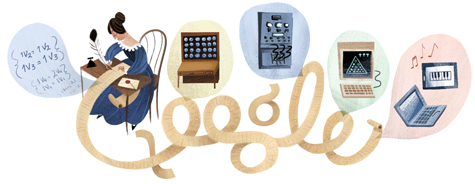
But, in the modern age, I think that the list of simple machines (3 or 6) is incomplete. When we examine what I am using to write this blog post, we come to the computer. As a coincidence of today, as we consider what components the computer can be simplified to, I would be remiss if I did not acknowledge today's Google Doodle:


http://www.google.com/doodles/ada-lovelaces-197th-birthday

 
The doodle of the day depicts Ada Lovelace and her contributions to Charles Babbage's computation machine. So, what simple machine can we take away from the computer? Would it be the monitor, keyboard, mouse, hard drive? Simplify it all down and we get to the microprocessor as the driving engine of the computer.

But even the microprocessor had predecessors: the microchip, the transistor, and the vacuum tube. Do any of these make the list? I would argue that they should not because each can be simplified down even more to the most base components. I would contend that the addition to the list of simple machines should be the circuit.

If you clicked on the link above for circuit, you would see that there are many machinations of the circuit and there certainly is an advantage when they are put to work (may not specifically be a mechanical advantage, but I do not think it would be a hard argument to make to fit the above definition).

So here we are, a historical list of 6 machines that can be argued into 4. Just as in the case of Pluto, what used to be historically accepted as fact should be modified in the modern age.

Do you agree?