
 |
| Graphic accessed from https://www.portlandoregon.gov/oehr/article/449547? |
What is a functional definition of social justice for schools?
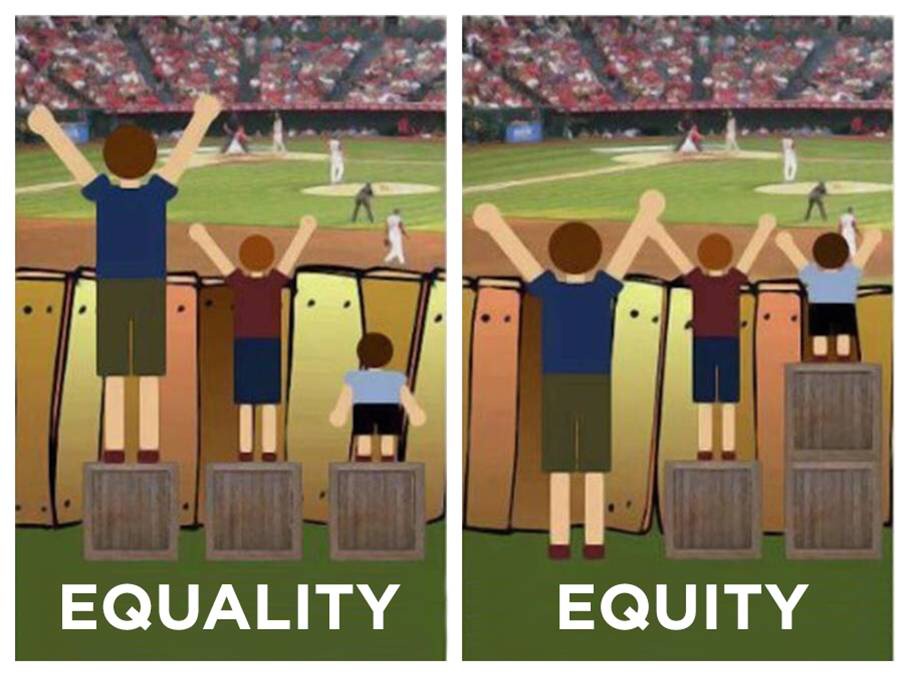
Schools and teaching are social justice. Social justice is about providing equity in resources and providing a voice for the typically under-served populations. With an understanding that equity is not the same as equal, there will be some students who will receive more than others, because they need it. A functional definition would include equal opportunity for all students along with community involvement and opportunities. It doesn’t mean everyone is the same, just need to provide same opportunities. And then from these opportunities to learn and teach, the social justice will occur when the lessons learned are applied in real life through a critically conscious curriculum.
It is about educators
ability to ensure that all voices, regardless of background, are heard
in the classroom. That students are able to achieve and move forward
with the right supports at the appropriate time without worrying about
how their backgrounds might impact their futures. Social justice is about giving voice to the voiceless and being about student-centered decisions and structures at schools that support success for ALL!
Social justice is treating all members of a community as equals. Treating each person with equal amounts of respect and valuing each person’s contributions equally. Also, it is accepting each person exactly as he or she is and never demanding that they change who they are. Removing barriers that stop voices from being heard - celebrating diversity and learning from them and their experiences as well!
Knocking down the classroom walls to not only let new people in, but to allow the learning to leave the classroom. Connecting students with the world around them will help foster a sense of empathy for others and bring pause for their own individual reflections.
Learning need to be created and experienced through multiple lenses and perspectives, not just that of the majority. Schools need to knock
down the classroom walls to not only let new people in, but to allow
the learning to leave the classroom. Connecting students with the world
around them will help foster a sense of empathy for others and bring pause for their own individual reflections.
What are some indicators that social injustices could be occurring in your school?
This section of the discussion caused some serious reflection on our own schools and learning environments that we provide for the community.
Dr. Lisa Stevenson provided the following for our post:
Data speaks volumes in uncovering social injustices!
-more boys in special education for behavior
- PTA not representative of school's minority and poverty
- teacher efforts and admin to reach the hardest to reach parents
- diversity of kids in extras like band, orchestra, intramural vs. summer school/after school tutoring
Joey Grace, a student at Illinois State University added:
Lately, I’ve been hearing about model nuclear families within literature found in the library. This can cause a distorted view for the ones not from the “typical” family. Also, within a clinical observation of a local alternative school I witnessed, or noticed, language and attitude can be detrimental. If we treat “gangstas” as such, then that behavior persist.
In general, schools need to look for misrepresentation (over or under) of individuals/voices among school groups: social, athletic, academic, or extracurricular. Are there opportunities for students to express their opinions and concerns? If no, that might be an indicator that injustice might be occurring. Why? The minority might not feel a chance to discuss what their individual needs are as a member of the learning community. Does our curriculum represent examples of the cultures that are present within our communities?
Specifically, within the learning experiences of students, we must ask the following questions: Who is being represented in the books that we read to our students? Are there races, ethnicities, types of families, religions, nationalities that are not being shown? Are we preventing students from seeing themselves reflected in the literature we read and the stories we share? Are we stopping students from building empathy for specific groups of people because we are not sharing their stories?
Look at the curriculum. Whose voices are not being heard? Whose version of history is not being told? We send strong messages to our students about what we value when we choose who to include in our curriculum and who not to include. If we leave out voices, we send the message that we don’t value their experiences.
As a part of building the culture and climate for the school among staff and families, there are other groups that can feel misrepresented or that they do not have a voice. This can be localized around students and staff who feel silenced or excluded or even a general feeling of apathy towards the school and community. How often do we listen to those with the least amount of power?
When we open the doors to our schools, do we notice who is attending? Possibly more importantly, do we recognize who is NOT attending? Are there certain groups of parents and students who continue to not have their voices heard?
Students are sometimes easily persuaded by their parents and older siblings. Parents can sometime send their children to school with preconceived opinions on certain cultures, races, and religious backgrounds. Students then take that as THE way to think. Having communication with parents/community and establishing a true sense of treating everyone as a blank slate, regardless of their background can help eliminate injustices from occurring. Students sometimes don’t even realize what they are saying or how they are acting is causing harm to others.
Discovering misrepresentation among student and community voices/demographics in extracurriculars, academics, fine arts, vocational, parent groups, and on and on. Examine why particular voices are either over or under represented.
In what ways do student & community voice shape the equity of resources and educational opportunities in your school?
One contributor described opportunities for community forums at the school and district levels. There have been chances for students, teachers, administrators, and community members to sit down with both building and district level leadership to discuss the current state of affairs and where they would like to see us go in the future. There have also been chances for community collaborations on grant proposals for community training sessions that would be desired.
Some other suggestions for for the inclusion of under-represented communities included ensuring the inclusion of stakeholder reps for all committees. This will assist in improving communication and making actions more transparent.
One contributor felt like we miss the voice of many when we rely on electronic means to invite, gather, record, etc. Social capital is not had by all and we must differentiate and value how we welcome and hear all of our communities and parents. When conducting needs assessments, do we include all stakeholders and how is the information requested? Too often, for ease of collecting and reporting, we will utilized electronic forms that not all community members may have
What kind of needs assessments do you conduct? Both student and staff. How are the results used? Are you partnering with other community resources? We created a Universal Leadership Team that combines the best aspects of Student Council with Key Club-type actions. They help develop leadership among students that isn’t stifled by top-down mandates.
Sometimes the types of events used to build community spirit can divide communities. School boards or board members with "agendas" can invite or stifle conversation. Even an invitation can act to stifle. The sense of homogeneity some schools adhere to is a myth--on the other hand, a facade of tolerance does not veil bigotry & bias.
What actionable steps would be recommended as a starting point to improve social justice?
As administration, single best thing would be to hire quality teachers! Include interview questions to gauge their level of passion. Additionally, administration can create opportunities for students to activate their voice within the school. (e.g. Principal Student Advisory Board, Community Coffees with the principal., etc.) Also, having school teachers and administrators go out INTO the community to meet them where they are instead of expecting them to constantly come to the school.
Student projects and learning should Include a variety of perspectives, within the social science realm, and implement real life actions to correct ills. And they don't have to be within the four walls of the classroom. To build empathy of students, they should connect to peers and experts all over the world. Pen pals of the 21st century include Twitter convos, cyber relations, use of digital tools such as Skype or the collaboration used to create this document are great ways to connect and learn and explore the world.
Some instructional tools to improve social justice and augment student voice were described and listed below:
- Hip hop as pedagogy! Giving voice to the voiceless, but more importantly, giving them their OWN voice! Story Corps has an awesome theme. Zinn-like!
- Flocabulary! ←--YES!!!!
- Literature can be a great vehicle to improve social justice in a school climate. Taking that a step further, trying to connect with an author, or the area in which the story takes place can truly be a powerful learning activity. Ex: reading about the religious extremists protesting military funerals, and then having a 1:1 Skype session with some of the families. Students take note of it and it changes their daily approach to learning and develop action plans to truly make a difference.
- Following social media sites geared toward social justice keeps a class up to date with latest world or local news. Assign home- or classwork so students engage in a dialogue about it. Build lesson plans from those current events.
- www.newsela.com
Overall, schools should give the people in your community a voice to tell their story. We can use technology as one possible vehicle to improve communication. Tell the story of your school and the people in it. Open the metaphorical windows and the doors to the school and this can be one way to combat community apathy. Engage the community and the students - allow students to connect with and understand the needs of the world around them by giving back to their own communities -- start local.
An important thing to remember is that actionable steps have to be two-way. We have to go where our families are as well as expect them to join us in our school home. Speak their languages (literally) is powerful and respectful. Honor their time (and culture). Show them that you will DO something with what they share that will affect THEIR child for the better.
If I wanted to learn more about social justice, where should I look?
Below are some contributed resources to learn about and explore issues related to social justice and schools:
http://www.sjli.org/ This is the website of the Social Justice Learning Institute. They have some great resources and programs that can be brought into your school.
Read closely. Think critically. Be worldly.

Social media sites. No links off hand but can contribute later. Zinn Educational Project Rethinking Schools (magazine and site) has a lot of useful information. I also personally follow social media sites, such as WBEZ Education or Teaching for Change twitter feed, I’m trying to dig through my following list! I hate to add the Badass Teacher Association with the recent claims of racism and other -isms, but they do bring to light social causes.
Someone switched up font size! Occupy and union pages also typically tweet/post a lot of social causes. Then we must use our creativity to form a lesson! Recent Israeli/Palestinian conflict was touched on in the summer issue of Rethinking Schools.
An oldie, but goodie is the magazine/website Teaching Tolerance
Social, Political, Economic and Environmental Issues That Affect Us All
Social, Political, Economic and Environmental Issues That Affect Us All
My district will be having Susan O’Halloran as our opening day speaker. She looks like a great resource for social justice: http://susanohalloran.com/newsite/
Conclusions
The development and collaboration of this post was a powerful learning experience for everyone involved. There were times of pure amazement watching multiple people contributing to a section at the same time. We were able to see people react to what other were writing and learn as they typed. This is one type of activity that could be easily brought into schools and let students learn and create with one another. The #iledchat team thanks everyone involved in the development of this post.
Collaborative writing team
Name
|
Twitter Handle
|
Role with students
|
Bob Abrams
|
@misterabrams
|
Associate Principal
|
Jill Maraldo
|
@jmaraldo
|
Associate Principal
|
Joey Grace
|
@JOS3PHGRAC3
|
Education student at IL State
|
Billy Spicer
|
@MrBillySpicer
|
5th Grade Demonstration Classroom
|
Adam Stevens
|
@MrSt3v3ns
|
Secondary Mathematics
|
Robert Schuetz
|
@robert_schuetz
|
Technology Coordinator
|
Kathy Melton
|
@kathyamelton
|
Elementary Principal
|
Jess Lifshitz
|
@JessLifTeach
|
5th grade literacy teacher
|
Dea Conrad-Curry
|
@DoctorDea
|
K-12 Literacy/CC Consultant
|
Nancy Powell
|
@NAPmath
|
Retired HS Math Teacher, now consultant
|
Judith Epcke
|
@jepcke
|
Director of Instructional Tech K-8
|
Lisa Stevenson
|
@lisamstevenson
|
PK-5 Principal
|

